|
| |
| |
| |
| |
| |
| |
| |
||||||||
Westwood Works 1903-2003 |
|||||||||||||||
Training for the RAF - The new multi-storey office block, completed in 1933, soon found itself involved in a very unusual, but, as later events would prove, important, activity. Having a large expanse of flat roof and being an obvious landmark, the Air Ministry commandeered the building in April 1934 for use in the annual week-long tactical exercises of the RAF Bombing Squadrons as part of navigation exercises to unfamiliar targets. A camera obscura formed from a tent with a lens in the roof was installed on the top of the multi-storey office block and used to plot the path of a puff of smoke released by an aircraft. This aided the plotting of the speed and direction of the wind - essential when determining the potential trajectory of a falling bomb. At night, white lights, fitted to the aircraft and flashed at the appropriate time, were used instead of smoke.
Flares on the Works roof identified it to the aircraft during the night hours. This led to a number of calls being received at the Works from people who were convinced that the factory was on fire.
The start of hostilities - At a series of meetings at the end of August/early September 1939, Josh Booth discussed with the Machine Shop Committee the Instructions that he had received from the War Office. He impressed upon the men that all instructions had to be followed to the letter "or we will be shut down". This applied particularly to the need to camouflage all buildings and to obliterate all lights.
The Black-out - As a temporary measure it was proposed to blacken all roof lights on the outside with matt black paint - if darkened on the inside with ordinary paint the glass on the outside would still reflect moonlight. This meant that work would have to be carried out, day and night, in artificial light. It was hoped that some kind of shuttering could be fitted on the roofs that could be closed at night but open in the daytime. Special arrangements had to be made above the electric welding bays and over the cupola in the Foundry.
Bert Slater tells us that shuttering was in fact fitted to the outside of the Shop roofs. In the Machine Shop at least, half of each section of glass was obscured with paint and the other half had a shutter that was pulled over at night. This allowed work to carry on in some degree of daylight. It is understood that these shutters - operated manually at first, were mechanised later in the War.
Evacuation: There was much discussion about evacuation in the event of an Air Raid. Some men were reluctant to leave their workplace and go into the Air Raid Shelters - they considered them dank and complained of foul air when the doors were shut. Josh Booth was of the opinion that - " 150 men can be in these dugouts for ten hours with the doors closed without any more discomfort than getting hot and dirty". (For the siting of the Air Raid Shelters see "Air Raid Shelters" below). The presence of gas would be signalled by the sound of a football-type rattle and the doors to the Shelters could remain open until this warning was heard. The Air Raid Shelters were to be equipped with "lighting, First Aid equipment and a gramophone (!)".
The ARP: Baker Perkins moved quickly to put in place ARP facilities at Westwood, spending a considerable amount of money on air-raid protection for its employees, including stores, a fully-fitted ambulance room and a decontamination room as well as enough air-raid shelters for 2,500 people. The ambulance room was fitted with a gas filtration pump for use in the event of a gas attack. The new Works Fire Station had been built and 48 firemen recruited and trained (See also The Baker Perkins Fire Brigade). There were now 80 members of the Westwood Works division of the St. John Ambulance Brigade plus a number of women first aid workers.(See also First Aid and St John Ambulance). The Company also built gas attack simulation chambers and an incendiary bomb training building.
As with so many other aspects of the business, in the matter of providing for their employees, Baker Perkins were well in advance of many other businesses.
The ARP Control Room was situated on top of the office block where messages and warnings were received and from where orders were issued.
Mr D.Y.B. Tanqueray was appointed ARP Director with T.W. Blake as chief instructor. The Internal Call Sign (buzzer) that had been used to indicate that someone was needed on the internal telephone was commandeered as a first warning to alert the Wardens to the possibility of an Air Raid, in the event of which sirens and bells would be sounded. Each section of the Works was allotted a specific Shelter with a Senior ARP Warden detailed to each. Fourteen Senior Wardens were appointed at first but later, when more of the Shop men and Works Office personnnel became qualified, one of each particular Department's men was put in charge of its own Shelter.
Fire Watchers: The Company was instructed by the War Office to appoint Fire Watchers in anticipation of Incendiary Bombs falling through the glass roofs. There was to be a series of little "hide-outs" or "forts" built about the Shops and Foundry. These were to be manned by three men plus a Foreman - all trained in the use of a Stirrup Pump. In the event of an attack, the Fire Watchers would leave the "fort" and render the bomb harmless before a fire could start.
(Following discussions with ex-employees who were at Westwood during the War, we wonder whether these "forts" turned out to be not much more than a hook on the wall on which a stirrup pump was hung).
Fire Watchers were volunteers and they would go to their "fort" should the alarm sound instead of to the Shelter. It was calculated that at least 60 would be needed but it was hoped that more would volunteer, as Josh Booth considered that - "Men would not want to be on this job for four years if the war lasts that long, so we want as many Watchers as possible so that we can change them round".
The length of watch was limited to when there was an actual Air Raid in progress but Fire Watchers had to be on site for 12 hours, day and night. In Departments that did not work a Night Shift at the time it was intended to start a Night Shift so that the Fire Watchers - "Would have something to occupy their minds".
Evacuations had been practised satisfactorily but there was some fear that gasmasks, which it was compulsory for each person to carry at all times, might be damaged in the congestion around the clocking in/out stations at the beginning and end of shifts. The number and siting of these was to be reviewed. (See also Clocking-on).
An important part of the Home Guard's activities was that of sentry duty. The instructions laid out below might seem to modern eyes somewhat comic but they were surely taken much more seriously in those threatening times:
"Questions have been raised as to the duties and responsibilities of armed sentries guarding vulnerable points and, in order to remove any possible misunderstanding as to their position, it has been decided that all orders for sentries guarding vulnerable points will be amended forthwith to include orders to the following effect:-
There were at least two sets of shelters - two underground shelters, located to the north of the Experimental Department and to the west of the Pattern Store, were quite long and dark and were used later by the Fire Brigade for training purposes. The shelters were filled with smoke and the firemen had to overcome a number of obstacles to get to the other end safely. The second set were located in the factory yard, on the right hand side facing north, approximately opposite the L70 office.
Harold Holmes recalls that, during his time in the Plate Shop, a Shelter existed outside the north wall of the Plate Shop, on what was the coal/coke storage area. This was brick-built, with a concrete roof and was accessed via doors in the Plate Shop wall. There was also an escape hatch built into the concrete roof.
This must have been demolished very soon after the cessation of hostilities to make way for the building of the new P4 Bay in 1946.
A 1941 Home Guard Spotters Log can be seen among the photographs above. Raid Spotting was an important task and one that was taken very seriously. An internal memo from 10th March 1942 from Mr. T. W. Blake provides an useful insight into what the job entailed and requested the Management and Works Committee to review the Raid Spotters' duties:
"Under the present system ten men are employed on three shifts of eight hours - 3 men to a shift. The reserve man is employed making model aircraft for instructional purposes, also on any other ARP job as occasion demands. Each shift consists of Nos. 1, 2 and 3.
All take turns in the various duties by mutual agreement.
Experience during the past year has proved that the roof patrol is essential during blackout hours only. During daylight hours, except during "Alerts", there is a tendency for the No.3 patrol to spend a lot of time in the telephone room owing, possibly to the monotony of continually walking round the roof.
I recommend that the No.3 patrol duties be dispensed with during daylight hours and that the man be more usefully employed doing other ARP jobs such as:
During "Alert" periods No. 3 would at once return to the roof, also relieve Nos. 1 and 2 as and when required.
No.3 duties would be on a rota so that each man would have a break.
The reserve man would also be employed on ARP duties as at present.
During the holiday periods and when several spotters were ill last year, it was found that the raid spotting during daylight hours could be done very efficiently with 2 men on each daylight shift and 3 men on the blackout shift, which with one reserve made a total of eight men. I found that there was more harmonious working with two men on a shift who were fully employed than there can be with three men only partially employed".
Typical Training Aids used at the time for aircraft recognition are shown below:
The experiences of the First World War led to a very real fear of enemy gas attacks and the Government decreed that everyone should carry a gasmask at all times. This law was strictly enforced regardless of age and occupation.
Periodic examinations of respirators by local authorities or by wardens became the norm. An Internal memo dated 31/1/1941 reproduced an extract from a Ministry of Supply Circular:-
"Anti Gas Precautions - All respirators should be regularly inspected and it should be ensured that all are in good condition and that defective respirators are promptly replaced as far as possible".
A
strongly worded instruction also appeared in the local press at the time. This
requirement to carry respirators at all times caused the management other problems
- see "Other Concerns" in "Preparations for War" above.
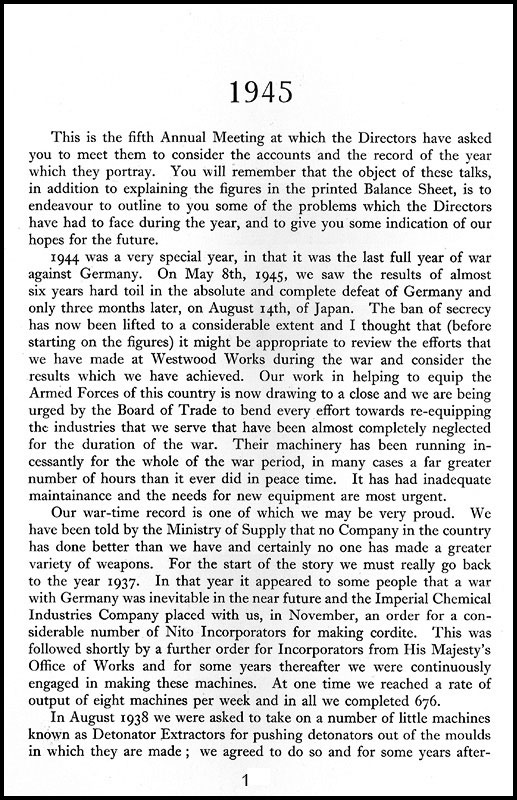
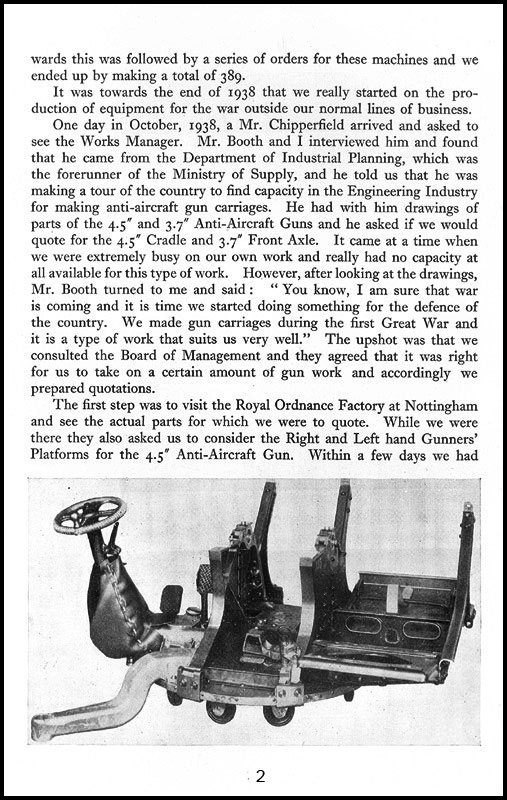
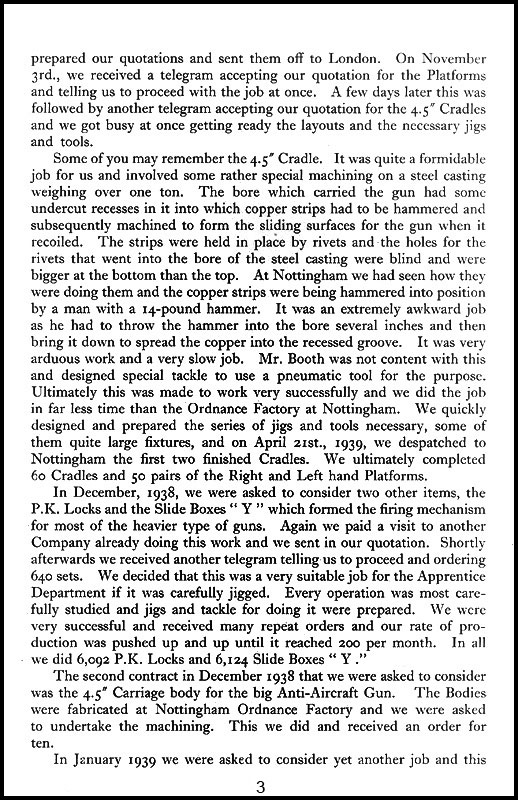
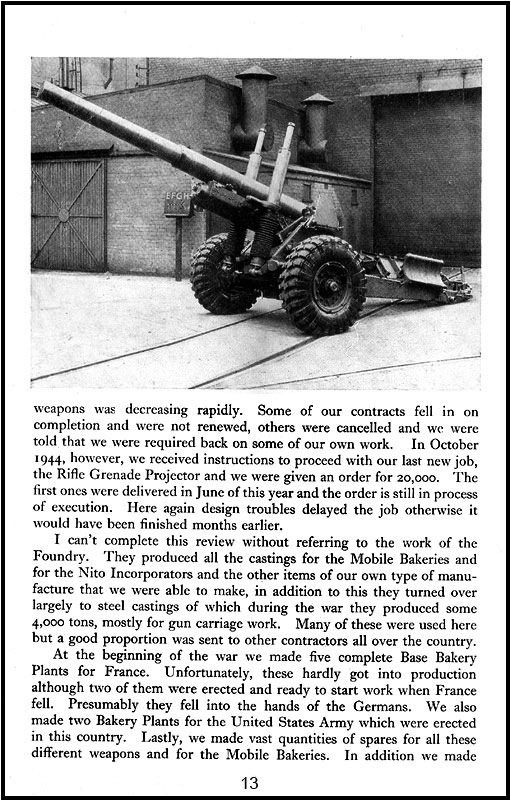
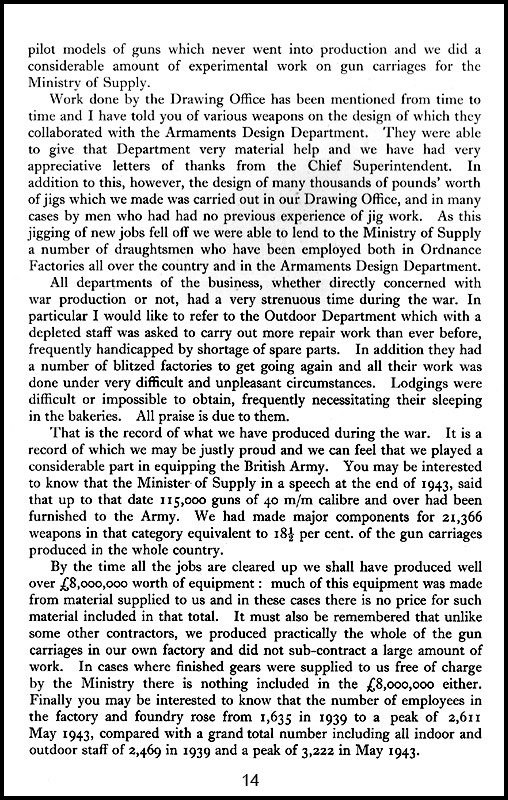
Below are pages from a book produced by Sir Ivor Baker at the end of World War 2:
With reference to the German reconnaissance photographs shown above. Despite its undoubted importance to the war effort, Westwood Works did not sustain any significant damage from enemy action during WW2. There is one event, however, that is still talked about today - the day that a German raider "strafed the Drawing Office". This was one of the first bits of 'history' that was learnt when first joining the company and, as with similar accounts, the tale varies according to the teller but there is little doubt that it has a firm basis in fact: The available evidence suggest that the event took place no later than 1942.
Some other events that happened adjacent to the Works involving friendly aircraft include:
Jim Farrow tells us that during WW2, the Strong Room - in the basement of the 1914 Office Building - was also used as an air raid shelter for the employees in the adjacent office areas. It housed blankets and fire extinguishers.
Florence (Graham) Morgan joined Baker Perkins in September 1938 at the age of 14. She worked in the Typing Pool before becoming a comptometer operator. Florence left the Company in 1942 but kept an address book containing details of those she worked with at the time.
If anyone has memories of any of those listed – or who is able to add to the list – please get in touch.
Background information kindly supplied by Bob Beales and David Gray of the
Soke Military Society:
On 14th May, 1940, the Government broadcast a message asking for volunteers
for the LDV (Local Defence Volunteers). On 23rd July, 1940, Winston Churchill
changed the name of the LDV to the Home Guard. The Home Guard was formed when
there was a real risk of invasion. Most men who could fight were already in
the forces, those that were left were either too young, too old, or in reserved
occupations (those jobs vital to the war effort).
The government was expecting 150,000 men to volunteer for the Home Guard. Within the first month, 750,000 men had volunteered, and by the end of June, 1940, the total number of volunteers was over one million. The number of men in the Home Guard did not fall below one million until they were stood down in December 1944. The Home Guard was disbanded on 31st December.
Peterborough was in Northamptonshire in WW2 and had two Home Guard Battalions; the 1st. Northamptonshire Home Guard Battalion - this was the Peterborough City Battalion, responsible for an area immediately surrounding the City from Paxton Crossing on the LNER railway line in the north, to Newark in the east, the river in the south and Thorpe Park to the west. and the 2nd. Northamptonshire Home Guard Battalion, the Soke of Peterborough Battalion, covering the area from Dogsthorpe, out through Newborough to Eye and beyond, a vulnerable area of some eighty square miles. These two Northamptonshire Home Guard Battalions were put into a larger group with Rutland Home Guard Battalion until 1942 when the Rutland Battalion linked up with Leicestershire Home Guard and the two Peterborough based Northamptonshire Home Guard Battalions were then grouped with he 1st. Huntingdonshire Home Guard Battalion (based at London Road Drill Hall, Fletton, Peterborough). Although under the Huntingdonshire Home Guard Area, they still remained Northamptonshire Home Guard Battalions.
L.D.V./ H.G. Volunteers of 1940 would have been put into units taking into account where they lived and not where they worked, so Baker Perkins employees could have been members of different units. However, Baker Perkins Factory did have it's own Home Guard Unit - part of B Company (**later "E" Company??) of the Peterborough City Battalion, the 1st. Northamptonshire Home Guard. Initially an infantry company, it later transferred to air defence duties with Hitler's introduction of V1 flying bombs (doodlebugs) in June 1944. (see Roland Maycock's memories below).
(**NOTE: There is some confusion regarding the title of the Baker Perkins Home Guard Company. Early photographs indicate it as "B" Company, later ones as "E" Company. Further research is being carried out on this).
Compulsory service of reserve occupation men into the Home Guard was introduced in 1942, with a requirement to carry out 48 hours duty per month. This was to replace those men being called up for active service.
In July 1942, the Northants 101st. A.A. Troop (101 Northants Home Guard “Z” A.A. Battery) – the only such unit in the county - was formed under the command of Lt. Col. E.W. Bromige. Their first home was Unity Hall. Because of the extreme necessity for anti-aircraft defence it was decided to use compulsory service Home Guard members for the “Z” troop instead of robbing men from other units, although some other compulsory service Home Guard members would also have gone to other units. A number of the Westwood men joined the 101st Z Battery and were trained to fire twin rail rocket projectors - anti-aircraft devices of which there were 64 sited on the playing fields in Fulbridge Road. The battery was formed of eight identical units who took turns to man the battery - approximately 1,500 men in total. (See Jim Deboo's account of his time with the unit below).
Directly under Anti-Aircraft Command for operations, a nucleus of Regular Royal Artillery personnel – a battery commander (Major), a second-in-command (Captain), four subalterns, one ATS officer, fifty other ranks and fifty ATS – was camped on the Fulbridge Road playing field site. These regular troops trained the Home Guard in basic infantry skills, rocket projector drill, plotting and instrument drill, aircraft recognition and anti-gas procedures. Each unit, or relief, performed one whole night’s duty once a week – from seven o’clock in the evening until they were released from the site (after being given breakfast) to return to work at the usual starting times. In similar batteries elsewhere in the country, members of the Home Guard manned the guns one night in eight but this was not possible in Peterborough due to the very high percentage of shift workers.
In March 1944, the A.A. Home Guard were regimented with the formation of the 10th Home Guard A.A. Regiment, consisting of the batteries at Peterborough, Leicester and Cambridge. At the same time, the rocket projector was removed from the secret list and the Peterborough unit became the 101 Northants Home Guard Rocket A.A. Battery.
"Z" Battery HQ Staff. |
|
Some of "Z" Battery's Officers. |
|
"Z" Battery on site in Fulbridge Road. |
|
Members of the Home Guard operating a Twin-rail Rocket Projector. |
Roland Maycock, who joined Baker Perkins as an apprentice in 1940, remembers:
"I was a private in the Westwood Works Home Guard Company. The work force was all privates as the order of command was the same hierarchy as in the factory, foreman and chargehands were sergeants and corporals and the Directors were the officers, a bit like Dad’s Army! In truth, though, it was not comedy, the bullets were real.
Initially, the Company was Infantry and we took guard duty on Saturday and Sunday nights at Westwood Works, the only two nights the factory was shut down. A platoon took turns for one night standing guard of the railway bridge over the river Nene, two hours on guard, the rest of the night off duty catching up some sleep in an adapted railway carriage at the end of the bridge. We had loaded rifles and the odd railway man wandering about got challenged “Halt, who goes there”, fortunately no one got shot!
We were mobilised on a few occasions, sleeping in local drill halls, no one knew why! We practised throwing hand-grenades in the quarry on Helpston Heath, and this caused a few problems when the throw was short and the grenade did not reach the quarry. One night a week was Company Parade, followed by rifle instruction, unarmed combat in the staff canteen. Rifle instruction was supposed to be using blank cartridges, a live round got mixed in the clip and the amazed instructor shot a hole in the ceiling.
With the coming of rocket-propelled bombs (doodle-bugs) the company was changed to anti-aircraft combat. The war ended before the plan was put into action, the idea being to mount twin browning guns (the same as used on the Spitfire) onto a swivelling stand with a bucket-seat; these would be positioned on top of the office building.
Training involved travelling to Heacham on the east coast, where one of these gun-platforms was mounted on a concrete plinth on the beach. The beach was mined! I believe the gun-mounting was designed by Albert Newby in Westwood Works. It was a three-man operation, one in the bucket-seat sighting the gun on target, and one man each side feeding the cartridge belts. The target was a sock pulled by a light aircraft flying along the beach, all hell was let loose when you pulled the trigger. The whole thing shook and you got a lap full of hot cartridges. The pilot deserved a medal. After a couple of passes, the pilot would drop the sock for examination. I never saw any holes!
Using the gun-sight was useless, so one bullet in five was made a tracer. You could watch the tracers and guide these towards the target. A major problem occurred if one gun jammed. The platform on its pivot lurched left or right before you could stop firing and everybody ducked. We stayed in the beach houses which had been commandeered by the regular army."
E Company's Sergeant Costin won the 1944 .22 Rifle competition. |
Bert Slater was member of D Platoon, the 2nd Battalion Northamptonshire Regiment
Home Guard. Its headquarters was at Manor Farm, Dogsthorpe - the home of Mr.
Odam - the Home Guard being allowed the use of his barn in inclement weather.
The Platoon included men from both Baker Perkins and Peter Brotherhood.
Lieutenant Glenn of Montague Road was the Platoon Commander, other members included:
2nd Lieut. Wallace
Sgt. W. Spendlow
Sgt. B. Butler
Cpl S. Hudson
Cpl. G, Hadman
L/Cpl. B. Slater
L/Cpl. Snow
Privates - R. Christian, Strancer, Grieg, F. Swan, J. Harris, Truss, A. Pacey,
Read, A. Read, Allan, Johnson, S. Horn, Knowles, Routledge, Johns, Day, Wallace,
Snow, Lawton, Goode, Roughton, Gamble, Alderman, and Ingle. Bert recalls:
"The sections paraded at Manor Farm on a Wednesday evening, with, on
occasions, an extra parade on Friday evening or Sunday morning. After Roll Call,
we had rifle drill, then on to Welland Road where we practised marching. The
officers and NCOs often tried to see how far they could march the men down the
road before giving the command "About Turn".We often got as far as
the thatched cottage near Bluebell Avenue.
Indoor training consisted of cleaning your rifle, what to do in case of a misfire
and how to hold it in various positions. Map Reading and Aircraft Recognition,
(see - Air Raid Spotters above), were very important skills to learn.
In the paddock at the rear of the farm, we were trained in the use of the Lewis
gun, Northover Projector - a sort of grenade launcher, the Spigot Mortar and
how to throw the hand grenade (we used dummies). The Butts were located in the
Dogsthorpe Brick Pits where we set up a range with a wall of clay facing the
Hodney Road. We took turns at firing and flag waving - to indicate a "Hit"
or a "Miss". Later on, Sten guns became available. These had a magazine
holding 32 rounds of 9mm ammunition and could be fired in bursts or single shots
(see - Jim Deboo's memories below).
Battle training was carried out around the Farm, entailing the use of camouflage,
blackening one's face and cutting up strips of hessian sacks to fix in the net
covering your steel helmet. We had to walk along the hedgerows, the order "Down"
was given and we crawled a short distance, observed the situation and then sighted
our rifles onto the target. This drill was sometimes carried out in gas-masks.
Bayonet practice was held on the sports field at Walton School, usually following
having done a night shift at the factory. Our instructor was RSM Stone from
The Drill Hall.
Patrols were undertaken mostly at the weekends, aimed at getting to know the
areas in which Paratroopers might be dropped. In the event of an air raid being
expected, we assembled at Dogsthorpe and then patrolled as far as Hodney Road
railway bridge near Eye, to make contact with the Eye Platoon under Lieut. Brown".
Jim Deboo also served in the Home Guard and he recalls:
"Some of us had tried on several occasions to join the regular forces but, because of the nature of the work upon which we were engaged, we were made to return to Westwood under a protected occupation scheme. But our chance came when early in 1942 we were drafted into the Home Guard. Now many present-day television viewers will enjoy a good laugh when watching episodes of Dad’s Army, but our Home Guard experiences were entirely different. Most Westwood men saw service in the Home Guard 101st Z Battery of the Royal Artillery. I was privileged first to be an NCO and then to be commissioned and had a fine group of machine shop colleagues in my troop.
A regular army (RA) major and other officers and NCOs took up residence in fabricated army huts on what is now the Fulbridge Road playing fields. During the very limited time we were not at work and especially on Saturday and Sunday nights (for those of us on night shift) we were drilled by an ex Black Watch regular sergeant named Munro and then, divided into reliefs and companies, we were trained to operate and fire the twin rail rocket projectors. Sixty-four of these were sited on the playing fields and, with two rockets to each projector, 128 rockets could be fired simultaneously, if required. This would mean that any aircraft caught in, say, a volume of space about one mile in each direction would be brought down! The rockets themselves, about 5’ long by 3” diameter, were fired electrically through any two of four contacts, each at 90º when located on the firing rails. If there was a misfire, we had to unload the missile and place it in a sand-filled bunker. It was never a happy time when a misfire occurred.
(Gordon Hennis, whose reminiscences of life in the Home Guard appear below, remembers the rocket installation well as his father, Henry Hennis was a plotter with "Z" Battery. Gordon recalls that a chicken hatchery existed on the opposite side of Fulbridge Road to the field containing the rocket projectors and one of the hatchery buildings was taken over by the Army as a plotting room).
Weekend camps by special train were also spent at Heacham and Snettisham facing the Wash – the bases of some of our buildings and miniature railway lines can still be seen there. We practised our drills (two men to each projector) and fired at a drogue towed on a very, very long line by a Westland Lysander aircraft over the sea. We had practised all one Sunday morning and had just been “stood down” when a Heinkel appeared from a cloud, dropped some bombs on the seashore and on our site and disappeared before even our Lewis guns mounted on top of the public toilets could open fire!
We learned infantry skills, including the use of the sten gun and there was an incident about which now one can laugh but which, at the time, was deadly serious. On the beach at Heacham some white marks were painted on large stones and placed about 25 yards away from us. The sten gun had a magazine containing 32 bullets and could be fired using R button for single repeat shots or A button for automatic continuous fire. At short range, we were told, a sten fired on automatic would “cut a man in half”. In my troop I had a very likeable but somewhat simple-minded man, a labourer from the machine shop, affectionately known by everyone as Wee Wee. When it came to his turn to fire the sten gun, I loaded for him, explained the two buttons, took his arm, pointed the gun at his marker stone and moved away. He was to fire single shots – the R button. Instead, he pressed A and, being alarmed at the gun firing off continuously, he swung round towards us saying “I can’t stop it!” We hit the dirt as one man and somehow I managed to point his sten into the air and out to sea. Oh, the joys of Z Battery Home Guard!"
Gordon Hennis joined the Home Guard fairly late in the War:
"At that time, when you reached the age of eighteen, you were conscripted into some kind of Home Defence work and I was conscripted into the Fire Brigade. However, before joining the Brigade , I decided to join Baker Perkins' Home Guard - at that time, an infantry company, all the members of which were Baker Perkins' employees. Most were veterans of WW1.
A lot of time was spent in infantry-based training - there was an old abandoned house in Gunthorpe Road which we were trained to attack or defend. We had WW1 rifles but no ammunition. On another occasion we were sent to guard the railway bridge over the river in Peterborough, spending the night in an old railway carriage and walking over the bridge every two hours. We also guarded Baker Perkins - a very small room on top of the original two storey office block, above the Board Room, was fitted with temporary beds and we patrolled the factory site during the night.
In the middle of 1944, the unit was transferred to Anti-Aircraft duties, the infantry activity being dropped but the same officers were retained. We were issued with twin Browning machine guns mounted on a frame with a seat behind them, the whole thing being capable of being rotated through 360 degrees. A big sight between the two guns allowed the device to be aimed. At the same time we were issued with new 'Bow and Arrow' shoulder flashes.
We were taken to Heacham, (there was very little there at that time, everything was sealed off and it was impossible to get down to the beach), several of the twin guns were set up along the coastline and we were allowed to fire them out to sea. On occasion, an old biplane towing a drogue would fly parallel to the beach and we were instructed in firing at the drogue - not as easy as it sounds despite having tracer bullets in the magazines, it not being unknown for people to fire at the aeroplane. The story at the time was that the pilots had committed some misdemeanour and were made to fly the target towers as a punishment. I cannot vouch for the truth of this!
RAF Westwood was still in operation behind Baker Perkins' factory and we were allowed to use a piece of their equipment - a brick-built building in the shape of a dome, some 20 to 30 feet in diameter. In the middle of this room was a framework from the guns but instead of the guns there was a camera. You sat in the chair and operated the camera when pressing the 'trigger'. All around the walls of the room were projected films of aeroplanes coming towards you. The object of the exercise was to identify the aircraft as friend or foe and 'fire' the camera as appropriate and it would be recorded. We used the equipment quite often and it was very good training - I enjoyed it anyway!"
The Home Guard played a prominent part in the many public morale-boosting civic parades and fund raising activities which were a feature of local Peterborough life during the war. Military music is essential to public parades but in 1940, on one of the first occasions that the Peterborough City battalion marched past a saluting base outside the Town Hall, they were led by an amplified gramophone, mounted on a lorry. The need for a proper band was obvious, plenty of old bandsmen existed in the ranks of the Home Guard, an experienced army bandmaster was available, the need was for some instruments.
The 1st (Peterborough City) Battalion Military Band on Kings School Playing field at the end of the War. |
Fortunately, a local philanthropist, Mrs F. Smith generously donated the substantial sum required to equip 23 bandsmen. Bandmaster B.V. Powe trained the players - band practice took place in Unity Hall - and the 1st (Peterborough City) Battalion band became the first in the Northamptonshire Home Guard Regiment. A number of the bandsmen were from Baker Perkins, the band eventually swelling to 40 members, and becoming one of the city's most important war-time institutions.
The 1st (Peterborough City) Battalion military band later spawned a dance band which played at many local functions.
The Home Guard Dance Band at the Drill Hall, Lincoln Road. |
One might have expected some friction between the regular servicemen of the "Z" Rocket Battery and the members of the Home Guard. However, the "once a week soldiers" of the Home Guard were soon accepted as equals. Christmas 1943 saw the Regulars on duty far from home but the Home Guard organised dances and concerts, determined to give the Regular boys and girls a good time. This hospitality was repaid in full by the Regulars the following year.
During the two years of co-operation with the Royal Artillery, "Z" Battery made great efforts on behalf of the Royal Artillery Prisoners of War Fund and £2,000 was raised over the period. Two gala nights were held at the Embassy Theatre in Peterborough when the revues "You've Z it" and "Watch the News" were performed.
The Programme for "You've Z it" |
|
The Home Guard was officially stood down on 3rd December 1944 when it was clear that the end of the War was in sight and all threat of invasion had passed. At the "Stand Down" the force handed in their rifles but were allowed to keep their uniforms. The Home Guard was finally disbanded on December 31st 1945.
During WW2, Westwood Works worked round the clock producing guns, mobile bakeries and other items for the armed forces, with both men and women working 12 hour shifts, day and night. At the outbreak of war the Company employed 120 draughtsmen and these were taken off the research and design work that had underpinned the Company's pre-war success, to work on the development of jigs to speed up the production of gun components. Many of these draughtsmen were later seconded to Woolwich Arsenal, Enfield, etc., returning to Westwood after the cessation of hostilities.
At the special request of the Ministry, the Foundry became a steel foundry and two more of the latest type of electric melting furnace were added to the one installed shortly before war began. The Plating Shop, where peacetime products had merely been embellished, was used to build up worn parts by hard nickel deposit.
The number of machine tools in the Shops nearly doubled. As some of these were very difficult to obtain, Baker Perkins set to and made its own - in incredibly short periods of time (some special lathes being in use within only twelve weeks of pencil being put to paper). With such a highly skilled workforce, "Setters-up" were never a shortage and dilutee labour - very largely women - could be trained and absorbed smoothly.
The main drive motor for a machine tool would be started up at 7.30 am on Monday morning and, running day and night, would not shut down until 4pm on Saturday, resume on Sunday, and start up again on Monday.
During the early part of the war years there was no canteen for the night shift, workers brought their own food and thermos flasks or billycans. Later, canteen facilities were introduced and people were able to eat a proper meal from 2.30 - 3am during a night shift of 8pm to 7.30am.
Bert Slater recalls the long hours worked to meet production targets. Even
before production reached its backbreaking peak, there was little time for pausing
on the job:
“You weren’t allowed to take lunch. You took a few biscuits
crumbled up in your pockets. The company never fell short of its targets but
plenty of sweat was spent in the process.
There was a board in the fitting shop telling us what the target was for the month. It might have been 50 25-pounders. We would be scratching around at the end of the month trying to meet it. We would get in at 7.30 in the morning and not know when we’d go home. Sometimes it was midnight, sometimes 2am and sometimes even 5.30, starting up again at 7.30. If you stood about for a minute, your eyes would begin to close!
Normal hours weren’t exactly a breeze either: 12 hours a day from Monday to Thursday, 10 hours on Fridays and eight on Saturdays and Sundays – 74 hours altogether. At the beginning of the war, following the destruction of Coventry, a siren would trigger an exodus to the air raid shelters, but soon this practice ceased. Too much production was lost when we spent all night down there”.
Roland Maycock had joined Baker Perkins as an apprentice in 1940 and remembers the war years:
"You worked on a range of machine tools, machining armament components to very close limits, all jigged and fixtured with special cutting tools. The completed work was inspected by (CIA) Chief Inspector of Armaments. Unskilled labour was used, men and women directed into industry to work on machines under the supervision of a skilled machinist.
Tragically, the Machine Shop had two deaths due to industrial accidents during the war period. A turret lathe operator on the night shift got his work smock wrapped around the bar stock protruding out of the rear of the chuck, this spun him over the bar, hitting his head on a stanchion. The second accident happened during testing 25 pounder recuperator block. These were hydraulically tested for leaks, each end of the block plugged with a screwed plug during the test. A plug blew out, hitting the operator in the stomach".
The precision required to manufacture biscuit cutters and moulding rollers provided the skill to produce the percussion lock, part of the breach block, firing mechanism of the 25 pounder field-gun. Work also continued to repair biscuit cutters and moulding rollers keeping biscuit plants in operation during the war years.
Tucked away in the corner of the fitting shop, away from armament production and later moved to the ground floor of the main office building, next to the Apprentice Bay. The department manufactured parts and repaired food machinery to keep customers’ plant on production during the war years. Dedication to the job was exceptional by the few people in this section. The main workshops were not set up for one-off jobs. The department had to make and mend with what they could find.
With the outbreak of war, part-finished machinery on the shop floor was crated and stored, the intention to complete this when the war ended. The SO department raided the packing cases looking for parts urgently required on breakdowns. It had a sting in the tail for me, as my first job in the Drawing Office was to sort out the parts for the biscuit cutting machine that had been stored and build up a specification to complete the order.
The department had four fitters, all elderly and very skilled. I learnt every trick in the trade from these men, one was called Joe. He always wore a brown smock and was permanently bent in the filing position, left shoulder lower than the right, from years working at a vice.
Len Barber was the chaser of paperwork and parts. He would wait for parts to be finished, collect these and often cycle to the Railway Station, despatching the parts for collection by Baker Perkins Outdoor engineer at the destination station. This service to our customers in difficult times prompted the saying 'God must live in Peterborough!'".
In December 1938, Baker Perkins was very much involved in discussing munitions manufacturing plans with the Ministry of Supply. The Company was asked to consider manufacturing two items - P.K. Locks and Slide Boxes "Y" - which formed the firing mechanism for most of the heavier types of guns. After seeing what was involved at another company already doing this work, a quotation was submitted and shortly afterwards, an order was received for 640 sets.
It was decided that, if carefully jigged, this was a very suitable job for the Apprentice Bay to tackle. The project was a success and many repeat orders were received, the rate of production being pushed up to reach 200 per month. In total, 6,092 P.K. Locks and 6.124 Slide Boxes "Y" were produced.
Jim Deboo, who joined Baker Perkins on the 18th January 1938, has some poignant memories of Westwood Works in wartime:
"It might have seemed to some that the war was remote, but small things – and some not so small – kept our motivation high. I remember fetching some job cards from the machine shop office and being given these by one of the section controllers who was in tears but carrying on with his work; his son had been killed in a Spitfire. One of the fitters attending to a rectification on a 25 pounder main trail and chassis on my horizontal borer had just lost his son in the Fleet Air Arm. One of the women crane drivers seemed not to be aware of what was going on around her; her husband was missing at sea. And so it went on. Bits of railway line came through the general stores roof and into the auxiliary machine shop from bombs dropped on New England railway sheds; the awful glow in the western sky when Coventry was blitzed; and the determination of the night shift not to spend hours in the air raid shelters during air raid warnings but to continue to work through. I recall, too, on 11th November 1938 and 1939 the whole of the workforce keeping the two minutes silence – all machine tools shut down – not a movement anywhere, except for Albert Allies, a crane driver, but also the conductor of the Salvation Army band, standing on the steps leading from the machine shop into the works office and playing “the last post” on his silver cornet.
Looking back over the years 1938-45 – so full of memories – it is difficult to pick out what some may regard as highlights. We knew at the outset and then after Dunkirk how desperately short Great Britain was of up-to-date armaments, and so the motivation was keen and the effort, I believe, by all and sundry, was wonderful. It was a great time to learn by doing and by experience. Innovation was encouraged and – in contrast to an incident early on in 1939 when I was fined 1/- by my AEU branch for machining five cast iron plummer blocks simultaneously instead of one at a time (making 300% bonus instead of 50% which was usual) – anything we could do to increase production was welcomed."
Text of Address delivered by Sir Ivor Baker to the Works, Staff and Outdoor Committees and to the Apprentices and Office Juniors at Westwood Works in 1946 |
||||||
WW1 Poster |
WW2 Poster |
During both World Wars, many ladies worked in the factory whilst their men folk were away fighting for their country. The photograph of the WP&P factory in WW1, together with many of the illustrations in Sir Ivor Baker's book which he produced at the end of WW2 (see above), amply demonstrate the crucial part which women played in keeping the wheels of industry turning as welders, crane drivers and machinists, etc.
Pre-war, the number of employees was about 2,500 on a two-shift system. During WW2, the factory worked right round the clock but still needed a further 750 employees. Of these, most were women.
War work had its lighter moments; indeed, some ladies we have spoken to smile even now when looking back. Sometimes minor embarrassments arose as females entered what until then had been a male dominated environment. Mrs W. Harrold was employed as a cranedriver on the high crane above I J Bay in the Fitting Shop. Unfortunately, the ladder to the crane was sited just inside the entrance to the men's toilet - which was at that time positioned between the Machine Shop and the Fitting Shop. The Maintenance men hastily erected a small ladder to enable her to get onto the toilet roof to access the crane ladder higher up. Later, this ladder was moved to the other end of the Fitting Shop, outside the entrance to the General Stores."
Jim Deboo (then working in the Machine Shop) writes "A special reference must be made to the women who adjusted so quickly and efficiently to exacting work and long hours when compared with the shop and office work, nursing and dentistry from which they came. Their contribution was vital"
Queenie Gavin was a welder in the Plate Shop, pictured here with fellow welders Muriel ?, Kathleen ?, Joan ?, and Barbara ?. We understand that Tony Scarr's mother was also a welder in the Plate Shop. |
Jim Deboo recalls that the women crane drivers were excellent - one especially named Ronnie. She worked in the heavy horizontal boring bay and could climb the steel ladder up to her cab faster than anyone else!
Alan Dann remembers Kath Morris, a rivet hotter in the Plate Shop and Ron Knight's wife who was a turret lathe operator in the Machine Shop. The "rivet hotter" heated rivets in a coke furnace until they started to spark, then used tongs to toss them into a bucket from which the "holder upper" placed them in holes for gun carriages for example, to be rivetted over.
Bert Slater worked with Mrs Garbutt and two other ladies in the Fitting Shop making recuperators for 25 Pounders. He also remembers Mary Cook working on a turret lathe
Miriam Fletcher (nee Rice), who began work at Westwood in 1934 recalls that at the beginning of the War:
"A notice appeared asking for operators for war work on the shopfloor. I applied, was accepted and signed on again on Monday morning as a payroll employee as opposed to salaried staff.
After a meeting, I was sent to one of the big engine lathes at the bottom of the steps leading to the Machine Shop. My foreman for 2 weeks of days was Jack Baxter followed by his son for two weeks of nights. Mr. Whiteman was my setter-up. I liked the work very much, most of my friends ended up on the turrets under Maurice Seago in Mr. Farmery's bay. Some of the work was commercial repairs but mostly we made parts for two pounders, Bofors, A.A. and 25 pounder guns.
It was through the latter that I met my husband. He was Bill Fletcher who came from Scunthorpe when he was made redundant from David Brown's in 1935. He was foreman of the Recuperator Bay, his opposite number being Russell Bullard. Towards the end of the war some men were returning, so most of the women were finished and the factory was getting back to normal."
We have been successful in identifying a number of the ladies who worked at Westwood during WW2. but it is suspected that this represents only a small percentage of the total:
| Mrs Garbutt | Fitting Shop | Mary Waszak | ?? | |
| Queenie Gavin | Welder | Mrs Watson | Cutter Shop | |
| Sybil Glaysher | Fitting Shop | Lil White | Cranedriver | |
| Edith Glithero (nee Walters) | Machine Shop | Iris Woodhouse | Machinist | |
| Celia Goodman | Turret Operator | Doris Woods | Cutter Shop | |
| Phylis Goodman | Welder | Kathleen Wright | Cranedriver | |
| Kathleen Hall | Rivet Hotter | Kathleen | Welder | |
| Miss Harris | Cranedriver | Barbara | Welder | |
| Mrs (Wally) Harrold | Cranedriver | Ronnie | Cranedriver | |
| Barbara Hyland | Recuperator Bay | Rose | Inspection? | |
| Ann Ingram | Rivet Hotter | Joan | Inspection? | |
| Vera Ellen King | Lathe Operator | Kathleen | Inspection? | |
| Mrs Knight | Turret Operator | Jean | Inspection? | |
| Dorothy Larman | Turret Operator | Jessie Steele | Inspection? |
We would love to hear from, or about, any other ladies who worked at Westwood during the War.
There must be many more stories about life in a man's world during the War. We would be very grateful to hear from anyone who may be able to add to the above memories.
Mary Wilson worked at Westwood during WW2 but not for Baker Perkins. Together with 5-6 other girls, Mary worked for the Ministry of Supply, correlating orders for armaments under N.H. Harry who had joined Baker Perkins with the acquisition of the laundry machinery business, Aublet Harry, in 1924. (See also History of Baker Perkins in the Laundry Business).
It had been foreseen that obtaining materials in wartime conditions would be a significant problem and another employee of Aublet Harry, D.Y.B. Tanqueray, who had been made a director of Baker Perkins in 1935, was put in charge of a new Materials Control Department at Westwood and proved a brilliant success, so much so that the Ministry of Supply asked for his services and he was appointed Deputy Director of Weapon Production. He had that department running so smoothly by the end of 1943 that he was allowed to return to Peterborough. Unfortunately, His strength had been undermined and he died shortly afterwards.
On a much lighter note, Mary Wilson's husband, Jack, was with the RAF in Africa, on Sunderland flying boats. He remembers that Mr Harry liked feeding garden birds but couldn't get coconuts. Jack had access to an unlimited supply and would buy them in Africa, shave them, write Mr Harry's address on the shell, affix a stamp and they were always delivered (or so he says)!
Inevitably some of the Westwood employees were called up, or volunteered, for Active Service. By 1940 there were 193 Westwood men in the armed forces and many other highly skilled technical staff had been loaned to Government Departments. By 1944, the number called up had reached nearly 400.
Each man left with an undertaking that, after the war, they would have priority for re-engagement over everybody doing like work who had joined the Company's service after they left. All received a gratuity and a system of allowances, administered by a special Committee of the Board. (See also - "Prisoners of War" below). By 1942 some younger women employees had also joined the Forces.
By 1942 some younger women employees had also joined the Forces.
A quarterly "newsletter" had been sent to each serving ex-employee since the outbreak of War and many appreciative replies with interesting news from the different War Fronts were received. The Company was represented in several branches of the Services during the landings on D-Day.
Regrettably, twenty of those who left Westwood lost their lives and their names are recorded on the Westwood Works Roll of Honour, 1939-1945 below.
Manning problems continued even after the cessation of hostilities. In 1945, Westwood welcomed back 100 men from Service but cancellation of deferment of younger men and youths led to a net loss of 60 skilled workers. The next year, 130 men were welcomed back but 95 more young operatives were called to the colours. 56 men and six women returned for the services in 1947 and 14, mainly apprentices were called up.
384 employees had joined HM Forces before VJ Day and of these 277 returned to the company, 87 did not do so and 20 are recorded as killed or missing.
As indicated above, the Company continued to be concerned with the welfare of its employees after they had joined the Forces and particularly should they have been taken prisoner by the enemy. An Internal Memo from December 1941 addressed this issue:
"By arrangement with the Red Cross organisation, relatives of prisoners of war are permitted to send out a parcel every three months.
Up to the present, four of our fellows have been taken prisoner, and on behalf of the directors I have written to relatives a follows:-
'The directors have heard with great regret of the fact that your son/husband is a prisoner of war.
The Board would like to add something to the quarterly parcels which you are undoubtedly sending through the Red Cross. If therefore you will undertake to add 10 shillings worth of suitable goods to your quarterly parcel, and will advise Mr -------- that this is being done by the Board, we shall be pleased to send you 10 shillings every three months for this purpose. It has been decided that this arrangement will date back to the time that your son/husband was taken prisoner'.
Will you kindly inform the Shop Committee accordingly as its members may be able to help by giving me names of any of our men who may be taken prisoner in the future".
In the late summer of 1939 a train load of 1914-1918 War vintage 6" howitzers was delivered to Westwood for conversion from wooden wheels and horse traction to pneumatic tyres and motor traction. The job was started but then priority had to be given to the production of 25-Pdrs and 5.5" guns. Then developments at Dunkirk changed priorities again and "a terrible rush ensued". Not all of this order could be fulfilled as some of the guns which were to be converted were lost at Dunkirk.
Some of the 1914/18 vintage 6" Howitzers returned to Westwood Works for refurbishing. |
It is worth taking a look at some of the individual weapons manufactured at Westwood in WW2 and illustrated above.
(NOTE: Many of the sights fitted to the guns assembled at Westwood works were manufactured at Rose Brothers, Gainsborough and at The Forgrove Machinery Company, Leeds).
In October 1938, a member of the Department of Industrial Planning (the forerunner of the Ministry of Supply) visited Westwood Works as part of a tour round the country to find capacity for making anti-aircraft gun carriages. The Company were asked to quote for producing the 4.5" AA Gun Cradle and the RH and LH Gunners' Platforms.
The 4.5 inch AA Gun was a British heavy anti-aircraft gun developed from the Royal Navy's 4.5 inch gun, and used for the defence of naval installations and large cities. It fired a 55 lb high-explosive shell to a height of 35,000 feet with a muzzle velocity of over 2,000 feet-per-second.
The Cradle was a formidable steel casting weighing over one ton requiring the acquisition of a huge new horizontal boring machine with an extra-high column. After visiting the Royal Ordnance Factory at Nottingham to see how these parts were being made, Josh Booth designed special jigs and fixtures to do the job in far less time then the Ordnance Factory. The first two cradles were delivered in April 1939 and, ultimately, Westwood turned out 60m Cradles and 50 pairs of Gunners' Platforms.
Jim Deboo recalls that a battery of these anti-aircraft guns was installed on the Grange playing fields at Westwood. "When they were fired, the discharge lit up the sky like lightning and the noise level was tremendous".
As early as 1937, Baker Perkins were involved in making preparations for national defence. War hadn’t even started when Baker Perkins had taken its biggest ever order, worth more than half a million pounds. The Ministry of Supply wanted 300 25-pounder guns and 100 5.5” Howitzer carriages and new lathes and tools had to be specially made for this job. Equipment needed to make them was too busy elsewhere to be spared, but the problem was overcome with such success that Baker Perkins eventually made 2,000 25-pounders. After seeing the designs and methods of manufacture then being used by the Ordnance Factories to manufacture various guns, Baker Perkins' engineering skills were used to re-design and/or re-organise the way in which many parts were manufactured. In particular, the forged recuperator on the 25-pounder was replaced by a welded fabrication - reducing cost and, more importantly, significantly increasing the production rate. There were only two drop-hammers in the country capable of making such a large forging and these were too busy making crank-shafts for Spitfire and Hurricane engines. The ingenious Josh Booth thought that the recuperator could be welded up out of thick-walled tubes and blocks and decided to make the experiment. This did not go down well with officialdom but Josh Booth went ahead and tested two out on 25-Pdrs with very successful results. The original one piece drop forged steel block weighed about 12 cwt (600kgs) and was reduced to one third of its original weight by machining, whilst the fabricated component only lost 10% of its weight in machining, an immense saving of eighty-seven man hours per recuperator. It was officially admitted that Booth had carried out a wonderful piece of work and the Booth recuperator became the standard on all 17-Pdr and 25-Pdr guns manufactured throughout the country.
| Original drop forging. | Fabricated recuperator - 25-Pdr machined forging in front, 17-Pdr welded tube design behind. |
It is interesting to note here that the manufacture of Recuperator mechanisms called for special lathes. Although the guns that they would help to produce were needed urgently, Baker Perkins were quoted a very high price and a 9 month delivery. It was decided that Westwood would have to make the six lathes itself and Josh Booth sketched out a design - "on the back of a matchbox" - as Ivor Baker drove him back from a meeting at Manchester. The first lathe was actually in use within 12 weeks of the Westwood designers putting pencil to paper, the average cost of production (which was a charge borne by the community) being less than a third of the price that had been quoted.
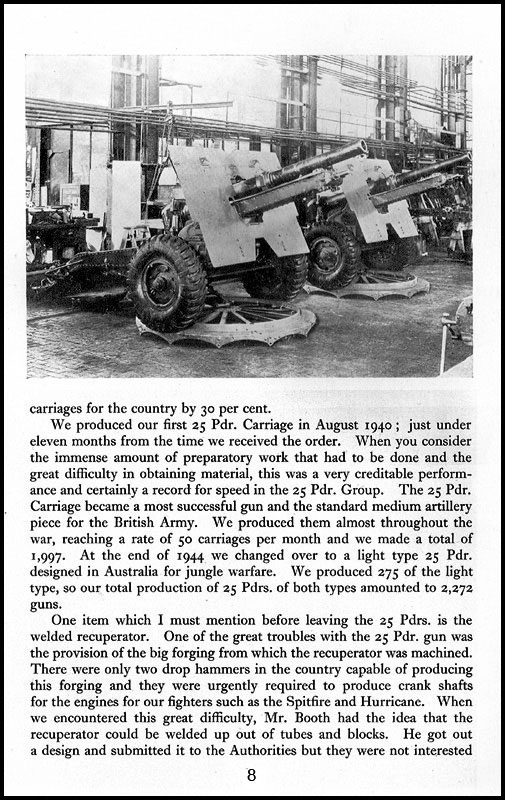
Some 3,000 of these welded recuperators were made at Westwood Works. The 25-pounder became the standard artillery piece for the British Army.
The idea of a gun to replace the 18-pounder and 4.3" howitzer and fulfil the dual role of gun and howitzer arose in 1918 and was revived in 1928. A pilot model was made in September 1930 and production began in 1935; the gun was already in service at the time of Dunkirk in 1940.
The calibre of the gun was .345" and the 25-pound shell had a range of 13,400 yards. High explosive, armour piercing or smoke shells were used and instead of fixed ammunition the 25-pounder employed a separately loaded shell and cartridge, permitting different charges of propellant to be used. The gun and its limber, carrying ammunition, was towed by a "Quad" -a four-wheeled, four-wheel drive tractor with an excellent cross-country performance and providing seating accommodation for the complete gun detachment.
One further innovation not known widely at the time was a demountable 25-pounder gun. Nowadays it is a well-known sight to see a huge helicopter carrying a field gun or a jeep etc in a sling suspended from the aircraft. In those days however that was not possible. However Baker Perkins made many 25 pounder guns in easily assembled pieces which could be dropped by parachute to our troops, assembled on the ground and put into action speedily. These was used with great effect in for example jungle warfare in Burma.
[NOTE:
The second part of the September 1939 order from the Ministry of Supply was for 100 4.5"/5.5" Gun/Howitzer carriages. A.I. Baker recalled:
"The design was not in a finished form when we received the order and it was some considerable time before we got complete sets of drawings. Pilot models were rushed through by Nottingham Ordnance Factory and when they came to be proof-fired they found certain faults which had to be put right on the drawings. We had many hundreds of alterations before we got into production. but in spite of these delays, we produced our first complete carriage in June 1941".
After producing 60 of them, Baker Perkins were asked to change over from the riveted to the welded design. After more delays and a great deal of re-organisation, production continued and Westwood made this carriage throughout the whole of the war. The last ones were made in August 1946 and, in all, 376 were produced, output reaching a rate of 12 per month. (A photograph and a superb water-colour of these guns are produced in Sir Ivor's book - "Wartime at Baker Perkins" reproduced in "Memories of Westwood Works in WW2" above - the second and third illustrations from the right in the third row).
The British Army relied heavily on this Medium Field Artillery gun/howitzer, it being possible to fit a barrel of either 4.5" or 5.5" calibre to a common carriage. Many of the Westwood-produced guns played their part at El Alamein and in the liberation of France following D-Day.
Originally developed in the mid-1930s, the Two-Pdr was no match for the heavier German tanks that it came up against in the North African desert. It did however fare somewhat better against the more lightly armoured Japanese tanks in the Far East.
In January 1939, Westwood began production of the Top Carriage and the Elevating and Traversing Gears for the Two-Pdr. The Traversing Gear was the main precision part of the gun - "an extremely tricky little piece of apparatus" - being a two-speed system, giving fast movement for target acquisition and a slower movement for precise aiming.
Production soon accelerated to 80 per month with a total of 1,850 being turned out.
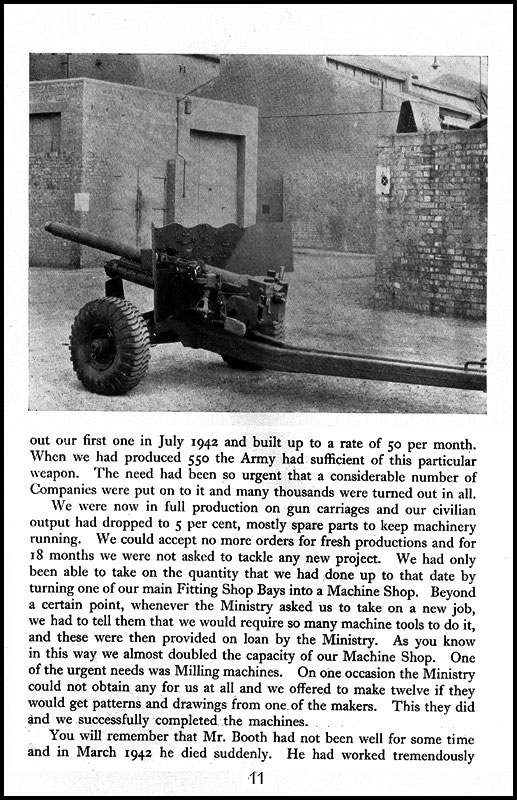
Even prior to the start of WW2, it was realised that the 2-Pdr would be soon out of date and the design for a 6-Pdr was begun in 1938. A prototype was test fired the following year but development was then put on hold until needed. The Fall of France and the loss of several hundred 2-Pdr guns left the British Army severely short of anti-tank guns and this, coupled with the poor performance of the 2-Pdr led to a proposal to develop the 6-Pdr. However, to get this into production would have absorbed all of the resources then used to produce the 2-Pdr and as, in 1940, a gun in the hand was worth any number in the pipeline - along with the fact that the troops were familiar with the 2-Pdr (and would need re-training on the new 6-Pdr) - meant that 2-Pdr stayed in production at the expense of the 6-Pdr.
The Ministry of Supply first placed a contract for 400 guns in June 1940, but it was not until the demand for the 2-Pdr was satisfied, that the first 6-Pdr guns appeared in November 1941. Westwood Works did not receive its first order for complete 6-Pdrs until August 1941 and turned out the first one in July 1942, building up to a rate of 50 per month. At this time, a considerable number of companies were producing the Gun and production ceased at Westwood when 550 had been completed.
We are grateful to Gordon Steels for the following:
"This is the story of how a very young apprentice unknowingly played a very minor role in the hybrid 17/25 Pdr anti Tank Gun that was put together in haste to stop the new German Tiger tank introduced into the 1942 battle for Tunisia.
Some time ago I bought a book at a charity stall titled ‘Artillery’ by a John Batchelor Ian Hogg, and one section dealt with the 17/25 Pdr anti tank gun. It related to the first battle with the Tiger tank when the 8th Army, which had chased the German Africa Corps from El Alamein to Tunisia, joined with the American 1st Army which had landed in Algeria.
The book stated that the 6 Pdr anti tank gun, the then standard British anti tank gun, (produced by Baker Perkins), only just held off the attack by the new Tiger tank. The book also states that 17 Pdr anti tank barrels were quickly flown to North Africa and fitted to existing 25 Pdr field guns to convert them into anti tank guns. The high chassis of the 25 Pdr field guns were not ideal for anti tank engagements where a low level of concealment is necessary, but it was a stop gap compromise to meet the new German threat.
Looking at the photograph in the book, I realised that the long 17 pdr barrel was anchored down in a split saddle at the very end of the recuperator component whereas the 25 pdr block has the saddle mid-way along the block for the shorter 25 pdr barrel. It means that it is almost certain that the new recuperator blocks would also have to be sent with the 17 pdr barrels to convert the existing guns to an anti tank mode.
The recuperator block is a component about five feet long with three bored and honed holes the length of the block and fitted with pistons. It carries the gun barrel which is fixed at the breech end with hemispherical keyways and held down in the centre of the block in a split saddle. The block is pressurised with compressed air which cushions the gun recoil as it fires, the recuperator block and barrel assembly sliding in a trough which is part of the gun chassis".
Baker Perkins’ engineers had the idea to produce a simpler fabricated recuperator from thick walled tubes in place of the original one piece drop forged steel block. At this time, the 17pdr gun was not in being and the first fabricated recuperator block prototype was produced with the 25 pdr field gun in view. (See "The 25-Pounder Field Gun above).
Reading the Artillery book opened up old memories for me, and so now to my very minor roll in the production of the prototype recuperator block as I remember it.
When heavy objects are electrically welded together, the conduction of heat at the point of welding to the mass of metal can affect the degree of fusion or penetration that takes place at the weld. Although the weld can be made to secure the components together, it can be a weak one with poor penetration, which is no use for a highly stressed component such as a recuperator which has to absorb the shock of a gun firing.
A solution is to heat up the components in a furnace before welding so as not to take away heat at the point of the weld and so help to get a good weld penetration. To keep the fabrication hot in the welding jig, someone had the bright idea of using the Baker Perkins design of electric heaters which were used for ovens and which happened to fit inside the length of the tubes of about three inches diameter.
It was usually the job of an electrical apprentice to hand-wind the spiral elements onto a small motor-driven mandrel, usually about 0.25 inches in diameter. The element is then stretched and wound around an assembly of ceramic spirals threaded onto a 0.375 square bar.
At the time it was my turn to wind elements, I think, for an electric oven for a navel vessel. Mick Mitchell, my foreman, handed me a reel of heavy resistance wire and instructed me to drop everything and to wind coils of a certain size and length and to get on with it straight away with no questions asked.
I found that my hands were not strong enough to guide the heavy wire onto the mandrel. (The health and safety people would have a fit today if they saw the then practice), so the task was handed over to Colin (Bocky) Bird who had hands of leather and could, when necessary, lift a live crane conductor back onto its supports with bare hands. So my part was relegated to stretching the elements and winding them onto the ceramic bar assembly.
At the time I had no idea what they were to be used for, and in those days we were not encouraged to ask questions. To this day I still do not know if they did the job and were used later on production recuperators.
So here to the end of the story.
If it were not for the Baker Perkins engineers’ original idea of fabricating the 25 pdr recuperator block and subsequently used at short notice to house the 17 pdr anti tank barrel to convert existing 25 pdr field guns to hybrid anti tank guns, the history of the Tunisian tank battles might have been somewhat different. It would have been impossible to get modified drop forgings and in any case they would have taken a long time to machine.
I do recall seeing a number of 25 pdr field guns under construction in the fitting shop being converted to the long barrel type, but I did not know then that they were stop gap 17/25 pdr anti tank guns.
Later, newly designed 17 pdr anti tank guns with squat chassis were produced, using the Baker Perkins fabricated recuperators on all 3000 of them".
Gordon Steels
April 2009
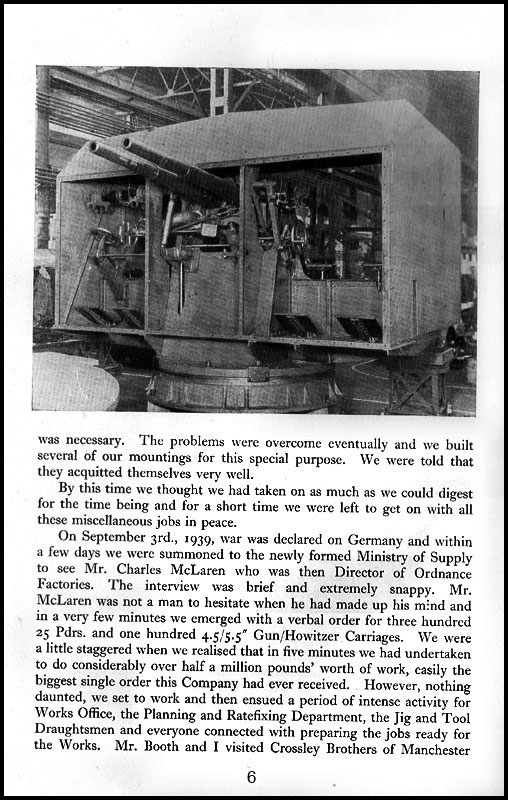
| Twin 6 Pounder mountings |
The origins of the Twin 6-pounder go back to the early 1920s, when the Royal Artillery Committee was asked to investigate the possibility of developing a rapid fire equipment to counter the threat of attack by Motor Torpedo Boats to harbours and fleet anchorages, and should also be capable of engaging low-flying aircraft. By 1925, after various trials, a design was submitted in which two 6-pounder guns were fitted with semi-automatic breeches and placed together in a cradle on a pedestal mounting. The mounting would also accommodate the gun layers and loaders, and would be protected at the front, sides and roof by an armoured shield.
In 1928, the first equipment was ready for trials, and these continued until the early 1930s and the new equipment was formally approved for service on 28th February 1934, the first production models being installed as part of the Singapore defences in 1937. The first installation at home was at Eastern Arm Battery. Dover, just prior to the start of the Second World War.
In March 1939, Baker Perkins was invited to Woolwich Ordnance Factory to see the new Twin 6-pounder and were asked to consider undertaking the whole job. This was a much more serious proposition than anything that the company had been asked to do previously as it was a mounting of considerable size. However, it included work for almost all the departments - a considerable amount of fabrication for the Plateshop, castings for the Foundry, all types of machine work and a lot of fitting. After a lot of preliminary study and a tremendous amount of preparatory work before it ever reached the factory, the first gun was turned out in March 1941.
As the war progressed the demand for the new equipment increased, far outstripping supply. By the end of 1942, 155 twin 6-pounders had been approved for service in 31 different locations worldwide.
The gun was such a success that Baker Perkins was asked to redesign it for ant-aircraft work. A.I. Baker recalled - "The official Armament Design Department was extremely busy and we were asked if, in conjunction with the Design Department, we would take on the Drawing Office work necessary. We were not gun designers but by this time we began to feel we knew something about it and agreed to do so. We encountered a good many problems but were successful and we made quite a large quantity of sets of conversion parts for altering all the mountings which were scattered about the world, defending harbours and estuaries in all parts of the Empire".
The Navy also took an interest in the twin 6-pounder and in 1944 and Baker Perkins were asked the adapt the Gun for yet another purpose. Many problems were encountered and a really major re-design was necessary. Six sets of equipment were ‘navalised’ and mounted in the ‘A’ position on escort vessels operating in the English Channel to counter the threat of ‘E’ boat attack.
By the end of the war, there had been a gradual run-down of our Coast Defences, but the twin 6-pounder installation programme continued, as did the manning of the Anti-M.T.B. batteries for fear of a ‘last gasp’ enemy attack.
Post war, the twin 6-pounder remained in service until the abolition of Coast Artillery in 1956.
Jim Deboo, who had joined Baker Perkins in January 1938, soon became involved in War Work and remembers working on the Twin 6-pounder:
"I had the ‘privilege’ of working on the prototype made at Westwood and then on the subsequent production models. Apart from the main frame and the supporting base, pretty much everything else was made from Admiralty bronze. I machined the transfer gear boxes (peculiar angles) for worm and worm-wheels – the main trunnion band casting and the casting carrying the gun barrels and the spring and hydraulic recuperation cylinders.
The huge cast steel base just fitted on our largest vertical borer [manned by Ted Chumely] and after very accurate machining was then ground. A huge steel ring was then inserted (to make what was, in effect, a huge roller bearing). This ring was hardened (Dick Bird – a foreman supervised this by using an intensely hot flame and instant water cooling). The hardened track was inclined at a slight angle to match the taper on the hardened rollers.
It was possible to push the whole gun round freely before the guns were connected for driving when in operation.
We were told that in some installations the angle of elevation/depression could be set, say, on a headland or entrance to a harbour, and then it would raise and lower itself in phase with the tide. Thus if an E-Boat rushed into the harbour it was then only a question of horizontal traverse to shoot the E-Boat out of the water!
Albert Newby, whom I succeeded as Apprenticeship Supervisor in 1947, later worked in the old experimental bay, adjacent to the old CPO, on a device fitted to some destroyers to maintain the correct angle of elevation of the ship’s guns firing starboard or port irrespective of the roll of the ship! "
NOTE: INFORMATION ON THE OTHER TYPES OF GUN MANUFACTURED AT WESTWOOD WILL APPEAR HERE LATER.
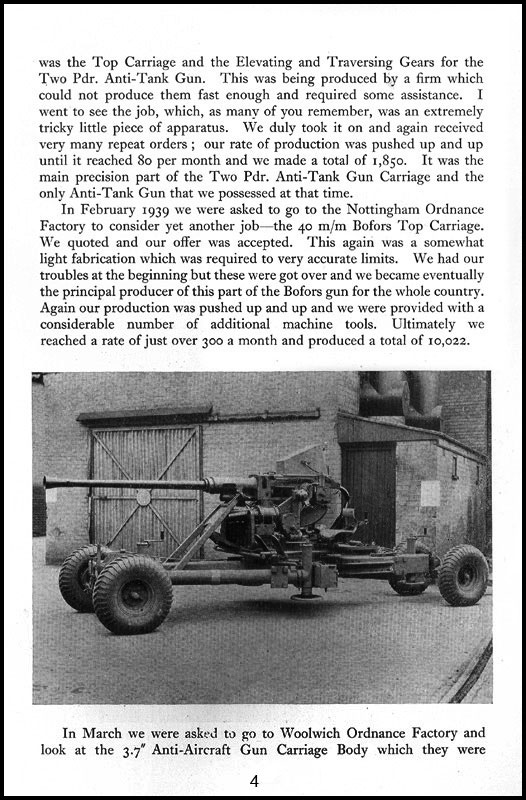
The Bofors 40 mm gun was perhaps the most famous gun that fired from British soil throughout WW2. Designed by the Swedish firm of Bofors, It was one of the most popular medium-weight anti-aircraft systems of the War, used by most of the western Allies.
The 1929 prototype showed that the major problem was feeding the weapon in order to maintain a reasonable rate of fire. A mechanism operating more like that used on medium artillery pieces proved to be the solution needed, improving firing rates to an acceptable level.
By June 1930 testing the prototype was complete and full-scale development began. By the end of 1931 it was operating at 130 rounds per minute. The development was needed to turn it into a weapon suitable for production, which was completed in October 1933. Most forces referred to it as the Bofors L/60, although the barrel was actually 56.1 inches in length, not the 60 inches the name implies.
A suitable towable carriage was produced in 1935 that allowed the gun to be fired from the carriage with no setup required, but with limited accuracy. When time was available for setup, the tow-bar and muzzle lock were used as levers, lowering the gun onto supporting pads. Two additional legs folded out to the sides, and the platform leveled with hand cranks. This process could be completed in under a minute.
In January 1940, A.I. Baker and Josh Booth were asked to visit Coventry inspect a 40 mm Bofors Travelling Platform. The platform, of Swedish design and of riveted construction, was felt to be very complicated and capable of being considerably simplified. In conjunction with Ferranti's of Manchester, proposals were made at the meeting to simplify the design. The Armaments Design Department agreed and the Ferranti representative accompanied the Baker Perkins contingent back to Peterborough where four of the company's draughtsmen worked throughout the night and by midday the following day had produced sufficient drawings for a prototype platform to be made. This was completed in ten days, and it went for trial. the trials were completed , the design approved and plans made for its production in large quantities by several contractors. Such was the pressure for results, and the company's response, in time of war. Westwood made 2,541 Travelling Platforms.
By mid-summer 1940, Baker Perkins were making top carriages for the Bofors and in the autumn, a start was made on manufacturing the whole gun, except the barrel. Westwood received many repeat orders and for some time, were turning out a steady 40 per month, In total turning out 894 complete carriages.
Late in WW2, a much lighter two-wheeled carriage for airborne use was designed:
As the War progressed, the need to more quickly and accurately train the gun to match the increasing speed of enemy aircraft became a significant problem. A complex mechanical analogue computer, the Kerrison Director, was produced by the British. This aimed the gun electrically and backup sights - a simple ring-and-post sight known as a "pancake", - were fitted to individual guns. However, the Kerrison proved too difficult to set up in combat conditions. Its electrical generator also needed to be kept supplied with fuel and, in most engagements, only the pancake sights were used, without any form of correction, Thus, the British versions of the Bofors were less capable than those of other forces. In 1943, a workable solution was developed at an anti-aircraft gunnery school at Stiffkey on the Norfolk coast. This consisted of a simple trapeze-like arrangement that moved the pancake sights to offer lead correction, operated by a new crewmember standing behind the left-hand layer. Many of the new Stiffkey sights were made at Rose Brothers at Gainsborough, a packaging machinery company that was later to join the Baker Perkins Group.
Rose Brothers of Gainsborough - also manufactured mountings and loaders for this 40mm gun. It was capable of firing 360 rounds per minute and could hit an aircraft travelling at up to 600 mph. The last of the British Army's Bofors was "de-mobbed" at Kirton Lindsey Rapier Barracks in Lincolnshire in March 1979, after 40 years service throughout the world.
The final British version of the Bofors that saw service was the STAAG - or Stabilised Tachymetric Anti Aircraft Gun - an enormous twin-barrelled unit that was stabilised and carried its own tachymetric (i.e. predictive) fire control system capable of "locking on" to a target. It was grossly overweight and the vibration when firing created problems with the sensitive valve electronics and mechanical computers. It is understood to have been produced in two versions – land based and naval (ship-based). The naval version of STAAG was assembled at Rose Brothers, Gainsborough, where part of the works was known as the "STAAG Shop" long after the end of WW2 (see also here).
STAAG was an ambitious weapon that was ahead of its time being too difficult to maintain in the harsh environment of a warship. It was later replaced by a single barrel version having the fire control equipment located remotely. and ultimately, with the Sea Cat missile – another development assembled at Rose Brothers, Gainsborough.
A.I Baker recalled - "Early in 1943 we were asked if we would collaborate with the Armament Design Department and the Director of Naval Ordnance in getting out drawings for a heavily armoured turret which was known as the 17/25 Pdr Mounting. This was designed for mounting on a special landing craft and in effect was like a very large floating tank, its purpose being to blast out pillboxes in amphibious operations. This job was extremely urgent and we agreed to help. In August the drawings were finished and we were given an order to produce a number of mountings. We were to push two Pilot Models ahead and in December 1943 we produced our pilots. Certain small troubles were experienced with these but they were quickly overcome and we went into full production in April 1944". Production ceased at the end of the war when a total of 78 had been completed.
In early 1943, Westwood was asked to consider another new carriage - for a 95mm light artillery piece designed to come apart for jungle warfare and transport by mule in the Far East. Westwood carried out a great deal of work in conjunction with the Design Department of the Ministry of Supply, getting out a Pilot Model that was completely designed at Peterborough from ideas furnished by the Design Department of the Ministry of Supply and a competitive trial was held between this carriage and one designed elsewhere.
A.I. Baker remembered - "Our carriage had an unfortunate accident to the gun itself (not the carriage) during proof and, while we felt it could be corrected quickly, the other carriage behaved very well and in view of the urgency it was decided to adopt it without further argument".
Baker Perkins received an order for the new carriage in June 1943 and the first one was finished in March 1944. In all, 300 finished carriages were delivered from Westwood.
TO BE CONTINUED
The second order received in 1939 was for a complete Mobile Bakery. Discussions had taken place on this since late 1936 and the company had submitted designs to the war Office in the years before the War. Baker Perkins had significant experience in this field, the development of mobile bakeries being the catalyst that brought the "Baker" and the "Perkins" sides of the business together during WW1. (See History of Joseph Baker Sons & Perkins).
Nothing was done until war actually broke out at which time a complete unit was ordered. This was rushed through as quickly as possible and after trials, further orders were placed. Five complete Base Bakery Plants were sent to France early in the war but these hardly got into production before falling into the hands of the Germans. Many mobile bakeries were ordered for American troops and two complete bakery plants were made for the United States Army in England, who highly praised them. In total, Baker Perkins produced 649 mobile Ovens and 205 mobile Bread making machinery units.
The Mobile Bakeries shown above were used, not only to feed the Troops, but helped to feed the civilian population where commercial bakeries had been put out of action by enemy bombing. Operating in two shifts of eight hours each, the large units were capable of baking the daily bread ration for a full division of 16,000 men. It is of interest that the mobile bakery received the honour of a place in the Victory Parade in London at the end of the War.
Baker Perkins Mobile Bakeries were deployed from 1951 to 1992 to local depots by the Ministry of Agriculture for mass feeding in the event of nuclear war or other civil emergency. (Source - The British Museum).
At the peak of the American boom in 1929, Baker Perkins Co. Inc. bought the whole of the assets of the Century Machine Company of Cincinnati, a manufacturer of bakery equipment for the smaller wholesale baker. During WW2, Century developed a portable field bakery. Made at Saginaw, this consisted of a wheeled oven and bread make-up equipment, not too dissimilar to that made at Westwood and illustrated above.The company was given the Army/Navy Award for its success in manufacturing thousands of these for all of the theatres of war where American troops were serving. To see this equipment, click here.
For a fascinating insight into baking bread for the Army, both during and after the War, please see this page on the Felbridge & District History Group website.
This is believed to be a reasonably accurate record of the numbers of specific types of military equipment produced at Westwood Works during World War Two:
Armament |
No. Produced |
Nitro-glycerine Mixers for ICI Ltd. |
676 |
Detonator Extractors |
389 |
Cradles and Platforms for 4.5" Howitzer. |
110 |
P.K. Locks for Firing Mechanisms. |
6,092 |
Slide Boxes for Firing Mechanisms. |
6,124 |
Two-Pounder Anti-Tank Guns. |
1,850 |
6" Howitzers converted from Horse to Motor Traction |
337 |
40mm Bofors Top Carriages |
10,022 |
40mm Bofors Travelling Platforms |
2,541 |
40mm Bofors Complete Carriages with Barrels. |
894 |
3.7" Anti-Aircraft Gun Carriage Bodies. |
386 |
6 Pounder Anti-Tank Guns |
550 |
17/25 Pounder Heavy Armoured Mounting. |
8 |
25 Pounder Guns |
2,000 |
17 Pounder Guns |
3,000 |
25 Pounder Carriages |
1,997 |
Rifle Grenade Projectors |
20,000 |
Complete 95mm Carriages |
300 |
Rivetted 5.5" Gun Carriages |
60 |
Welded 5.5" Gun Carriages |
376 |
Field Bakery Ovens mounted on Trailers |
649 |
Bread Making Machinery Units on Trailers |
205 |
Mr L.F. Aldridge
Mr L.G. Bowles
Mr H.J. Brown
Mr E.S. Bucknell
Mr W.H. Chapman
Mr W.H. Cobbert
Mr F. Dingley
Mr J.W. Gage
Mr L.F.B. Goodwin
Mr J.W. Harlock
Mr E. Hodgkinson
Mr R.L. Jinks
Mr A. Johnson
Mr F. Kingerley
Mr E. Knight
Mr H.L. Ladds
Mr C. Regan
Mr N.C. Tatum
Mr B. Westwood
Mr F.C. Wright
At this point, it seems appropriate to touch on the subject of National Service. To those joining Baker Perkins soon after the end of WW2, the words "National Service" possibly conjure up images similar to those portrayed in the TV show - "Lad's Army" - coupled with memories of the black cloud hovering over the end of their apprenticeship, when the dreaded brown envelope would land on their doormat. However, "National Service" had been a feature of life for some time before that - the need to balance the country's security with the availability of sufficient productive manpower having caused problems for industry since WW1.
Britain, unlike other European countries, had always relied on volunteers to fight in times of war. Conscription had been introduced in 1916 when more men were needed to fight in the trenches. Their work in the factories, including Westwood Works, was taken over by women (see Westwood Works in WW1). Conscription was abandoned when the war ended.
During the 1930s, there were 200,000 soldiers in the British army. It was clear that this was not enough to fight the expected war with Germany and in April 1939, an Act was introduced requiring all men between the ages of 20 and 21 to register for six months' military training. At the same time, a list of "reserved occupations" essential to the war effort was published - Dock Workers, Miners, Farmers, Scientists, Merchant Seamen, Railway Workers and Utility Workers (Water, Gas, Electricity). Those employed in these jobs being exempt from conscription.
With the outbreak of war in September 1939, the number volunteering to join the armed services was only sufficient to raise a force of 875,000. Other European countries had kept conscription between the wars and were able to raise much larger armies and in October 1939, it was announced that all men aged between 18 and 41 who were not working in 'reserved occupations' could be called to join the armed services. Conscription was by age and in October 1939 men aged between 20 and 23 were required to register to serve in one of the armed forces, being allowed to choose between the army, the navy and the air force.
By the end of 1939, conscription into the armed forces saw more than one and a half million men recruited for military service. A Schedule of Reserved Occupations protected young men in specified key occupations from being conscripted into the armed forces with, by the end of 1940, more than 200,000 men qualifying for deferment of National Service.
As the war continued men from the other registered age groups received their "call-up" papers requiring them to serve in the armed forces. Men who were too old, young or not completely fit joined the Home Guard - to be joined in 1942 by men in "reserved occupations" - see The Home Guard above.
Conscription of so many men created a severe labour shortage in the country - the impact on Baker Perkins of losing so many skilled men is covered in The History of Baker Perkins Ltd - The World War Two Years, and - The Post-War Years - Building for the Future.
In December 1941, legislation was passed that required unmarried women aged between 20 and 30 to be conscripted to help in the war effort. Married women were later included, but pregnant women and mothers with young children were exempt. Women did not take part in the fighting but were required to take up work in reserved occupations - especially factories and farming - to enable men to be drafted into the services, (See Women at War above). At the end of the War, women were no longer required to be conscripted.
War had inevitably disrupted apprenticeship training and in 1945, concern about a possible shortage of skilled workers led to a series of measures being introduced, including the Interrupted Apprenticeship Scheme. This enabled those whose apprenticeships had been interrupted by the war to resume them.
The requirement for a peacetime force larger than that made possible by purely voluntary recruitment led the establishment of a national service system in 1945. The Act initially required a period of one year to be served in the Armed Forces followed by a possible five years in the Reserve. In 1948, financial crises, the advent of the Cold War and the Malaya emergency led to an increase in the period of service to 18 months. This enabled National Servicemen to be used more efficiently and effectively, particularly overseas. The demands of the Korean War (1950-1953) led to the length of service being extended to two years, the liability to further service in the Reserve being reduced with each of these extensions. The period of service remained at two years until the end of National Service.
The "call-up" usually came at the age of 18 but it was possible for a young man to ask for deferment and those who were on apprenticeships or who had started a degree course were usually given deferments, normally until the age of 21, without question. This was not, however, always the case, particularly at around the end of the war, as evidenced by Bob Hay's experiences described in the preamble to Training Facilities.
"National Service" did not necessarily mean joining the three armed services. As Britain was unable to import coal during World War 2, the production of coal from mines in Britain had to be increased. (The problem was said to be exacerbated by the Government failing to declare mining as a reserved occupation, thus creating a rush of miners into the perceived easier occupation of munitions). To meet the need for more labour, it was decided by the Minister of Labour, Ernest Bevin, that from 1943 to the end of the war, one in ten of the young men called up would be sent to work in the mines. These conscript miners were given the nickname "Bevin Boys". An estimated 48,000 boys - who were too young for army service - were recruited into the coal mining industry under this scheme, many being conscripted by ballot, without choice. The alternative was prison.
(After the war ended, discipline amongst the men conscripted for the mines went into decline due to the disparities for demobilisation between them and the men in the armed forces. With the ending of the order for prosecution of Bevin boys for non-attendance it became impractical to retain the compulsory labour force and in 1947-48, 20,000 young men left the coal industry on the completion of their National Service. It was ironic that until the ending of National Service, many young men went into the mines to avoid serving with the armed forces).
Baker Perkins employees were called-up into any one of the armed services, although most went into the army. Some saw action in one or other of the "hotspots" - Malaya, Korea - and others witnessed the H-Bomb tests on Christmas Island in the late 1950s. It is believed that at least two - Roger Ward and Horace "Sos" Mellows - became "Bevin Boys".
Roger Ward remembers the early days of his apprenticeship and his time as a "Bevin Boy":
"In August 1939, I was fourteen years old, had just left school and had started work at Baker Perkins. At that time, it was difficult to get into work and some boys had to wait up to a year before they got a job. Only a few days after my joining the company, war was declared.
It was not possible to begin an apprenticeship before reaching the age of 16, so until then I worked in the works drawing archives and acted as a general run-about. My wage was 9s 7p (old money) for a 48 hour week; with one week’s annual holiday plus bank holidays. (See also A Pre-War Apprentice).
At 16, I started an apprenticeship and went into the apprentice bay where I milled percussion blocks for 20 mm and 40 mm Bofors guns. (See also Training Facilities and above). On reaching 18, with war work in full swing, I moved into the main works on day shifts and night shifts, working a 72-hour week. In those days all the machines were driven by lay shafts and belts, (see also Power Supplies). The toilets, metal cubicles approximately 4ft high enclosed in a metal ‘shed’, were in the centre of the workshop. The ‘clocking on’ places were positioned throughout the works - if you were more than two minutes late, you lost a quarter of an hour’s pay.
In 1944, at the age of 18 years 6 months, I was conscripted into the coalmines as a ‘Bevin Boy’. The reason why I had to go was that I would not sign any deferment papers. I had intended to go to Cardigan for three days to join the RAF but this was cancelled because my registration number finished with a 9. Here I should explain that, for a short period of time, those whose registration number finished with a 0 or a 9 became Bevin Boys. With no deferment papers, the company could not hold me and I was told to report to Bentley Colliery, South Yorkshire.
The first day I arrived, there was no place for us to lodge, so we slept in the school hall for three nights. The attitude of the local people was, perhaps, understandable - their sons had been conscripted into the forces, were being killed and we were taking their jobs. (Bad government management!). However, being true Yorkshire people, they soon accepted that we could not help the situation and gave us lodgings. I had two sets of lodgings and at the last one; the son had been killed only six months before. In the end, I was treated like a son and I kept in contact with them until they died.
We had four weeks training at Askern Colliery, just north of Doncaster. This turned out to be more like a get fit exercise, following which I was sent straight down the mine.
The working environment was different from anything that I had been used to. We caught the pit bus at 5.15 am - after a short while I cycled the five miles from my lodgings to the colliery - to be down the pit before 6.00 am. The pits were very hot and very dusty and it is understandable why so many miners developed lung complaints. Most miners chewed tobacco to keep their mouths moist. We were fortunate in that we had pithead baths where we could shower and change, but some of the older miners would not use them.
I started as a pony driver, taking empty tubs to the coalface and bringing full tubs back. There were 190 ponies underground at Bentley Colliery when I first started (they never saw daylight) and there were only about 40 when I left - the pit had become mechanised in that period of time. Later, I had the job of breaking-in new ponies. I spent the last six months actually working on the coalface.
I lived in a village called Adwick-le-St, which had a grocery, paper shop, post office and a fish and chip shop. The life of the village revolved round the working men’s club. Every Saturday and Sunday night they had a stage turn. Copious amounts of beer were drunk and Monday mornings were a disaster. You had to look after yourself because fights were frequent, but very often forgotten by Monday.
After 3½ years, I was de-mobbed and went back to Baker Perkins as I had three years’ apprenticeship to finish. This was reduced to two years. During this time, you did exactly the same as a skilled man so, on reflection, it was a form of 'cheap labour’. At that time, it was a ‘closed shop’ with everyone having to be in the union.
I was too old to get ‘day release’ to go to the Technical College, so to better oneself, it was necessary to spend three evenings a week for three years at 'The Tech’ to get the O.N.C., a further two years to get the H.N.C. and another two years to get endorsements. This was hard going when you were already working one month on day shift and one month on night shift. Thank goodness, those days have gone and young people now have many more opportunities. Armed with these qualifications, I managed to get into the Drawing Office and the rest is history. (Roger Ward - 6th July 2007). (Roger went on to become a chief engineer in the Drawing Office, then sales manager, finishing his career as site project manager with Special Projects).
Although the Bevin Boy scheme had ended by 1951, "National Service" or the "call-up" finally came to a halt on 31st December 1960 and the very last National servicemen left the Army in 1963. It should be noted that, on completion of National Service, every Baker Perkins employee was guaranteed their job back - as had been the case with those Westwood men who served in the forces during the war (see The Westwood Men Who Went to War above). Time spent on National Service also counted as part of their continuous service as stated in Baker Perkins Ltd's “Works Handbook” of June 1961:
"Seniority, i.e. length of service, will be all continuous service recorded in the Personnel Records of the Company. Service in H.M. Forces or in time of war in other National Services shall only qualify for computing an employee’s continuous service provided that such National Service was compulsory by statute and provided that the employee concerned was in the whole-time employment of the Company for a period of not less than four weeks before such Service and that he resumed his employment with the Company immediately on release from that Service”.
In fact, the Company sent a letter to each National Serviceman, one month before he was due to be discharged, requesting him to make arrangements to attend an interview at Westwood Works.
The section of this Website that attempts to describe the "unique" culture which permeated Westwood Works and the "family" feeling which this engendered - The Westwood Works Culture - describes the efforts made by the Company to ensure that Conditions of Employment for all its employees compared favourably with any in the Industry. It comes as no surprise therefore, to note that efforts were made to ensure that employees called-up for National Service were not disadvantaged, special arrangements being made for them within the Baker Perkins Pensions and Life Assurance Schemes. The concessions added to the Rules of the Schemes in 1951 are described in The Westwood Works Culture - Company Employees on National Service.
As National Service was a significant episode in the lives of those Baker Perkins employees who were called-up, it is worth recording some of their experiences.
Ron Jones ‘enjoyed’ an eventful period of National Service:
“I joined the RAF on 23rd April 1956, St George’s Day. After kitting out at Cardington, I was posted to R.A.F. Bridgenorth for square bashing after which came a posting to R.A.F. Hereford for trade training.
My
next posting was to R.A.F. Wyton, a 100 Squadron Detachment, which had been
specially set up to take part in ‘Operation Grapple’ - the British
Megaton Trials (Hydrogen Bombs) - on Christmas Island, a remote coral atoll
2 deg. north of the Equator, taken over by the army, navy and air force.
We went to Christmas Island in April 1957, our Squadron’s task being to fly Canberras on weather reconnaissance and sampling sorties after the first bomb was dropped on May 15th 1957. The Island was very hot and humid, with coconut palms, an abundance of land crabs and a few scorpions. There was a small settlement of natives, which I never saw. The sea had a variety of species - sharks, rays, octopi, etc.
There were four nuclear tests, which took place over Maiden Island, about 400
miles from Christmas Island. On the day of each test, we were loaded into trucks
until the aircraft carrying the bomb was airborne. If anything went wrong, we
had an hour to get off the island!!
(The aircraft involved, XD818, a Valiant of No. 49 Sqn, is now preserved at the RAF Museum, Hendon).
We left Christmas Island in August 1957 and returned to R.A.F. Wyton where our Squadron Detachment was disbanded and I was transferred to 58 Squadron, working on Bomber Command Publications, involving aerial photographs and top secret information, until my demob”.
Walter Seaton joined Baker Perkins after doing National Service.
Called up in November 1949, at the age of 18, and wishing to join the RAF, rather
than the infantry, he managed to persuade the RAF officer who interviewed him
of his suitability for that service by recounting his experiences of watching
the aircraft on Westwood Aerodrome. Somewhat to his surprise, he was accepted
and reported to RAF West Kirby, near Liverpool for initial training.
He recalls being thrown together with boys from all walks of life, far from
home, as a very quick growing-up experience. Following this, he transferred
to RAF Cosford for trade training, as a flight mechanic. Walter remembers this
time as being particularly taxing with a need to assimilate a great deal of
information in a relatively short time. Standards and expectations were high
but Walter completed the course satisfactorily.
The next challenge was to secure an overseas posting. Of the two previous intakes,
only a few of the first went overseas, around half of the second were successful
but all of Walter’s intake was posted overseas. This was the time of The
Malayan Emergency - a state of emergency declared by the British colonial government
of Malaya in 1948 and not lifted until 1960 – a key “hot spot”
and Walter was posted to RAF Seletar, Singapore. In May 1950, he boarded a Hastings
transport plane at RAF Lyneham and began the long journey to Malaya. These were
the days before direct flights and stopovers were the order of the day, allowing
Walter an unexpected opportunity to see a fair proportion of the world.
The first port of call was Malta, followed by Fayid – Egypt, Habaniya – Iraq, Maripur – Pakistan, each leg of the journey taking a day, then on to RAF Negombo – Ceylon, for a 7-day stopover before boarding an Avro York for the flight to Changi – Singapore, finally arriving at Seletar, Singapore.
RAF Seletar was central to the RAF’s presence in Southeast Asia between 1928 and 1971. During World War 2, the Japanese first bombed Seletar and then operated it as an airfield and support base for Japanese and German submarines. After the War, the base reverted to the RAF, the first of their aircraft to be housed there being the famous Sunderland flying boats. In the late 1940s and 1950s, the base was heavily involved in the Malayan Emergency servicing Dakotas, Beaufighters, Spitfires and Mosquitos operating against Malayan Communist insurgents.
Because of the contrast in skin tone between the old hands and the new boys straight from England, Walter and his intake were known as “Moon Men”. His education in life skills continued, confessing to enjoying every minute of his time in Singapore, forming friendships which were life lasting – over fifty years later, he is still in regular contact with at least four of the men with whom he served.
As a National Serviceman, Walter always worked with a regular RAF fitter and was at Seletar when the first Vampire jet fighters to join a squadron of the Far East Air Force arrived there in December 1950.
Last of the Spitfires |
First of the Vampires |
With the beginning of the Korean War in June 1950, the base – and Walter – was involved in preparing Spitfires that he believes were to be used for photo-reconnaissance in that conflict.
Walter describes life at Seletar as “one hell of an experience”. Life on the camp was made easier by the “Sew-Sew” girls who were allowed into camp to sew on buttons and keep the airmen’s kit in good order. A “bearer” would make the bed and polish shoes for $2 a fortnight.
Saturday nights were spent in Singapore at one of the three amusement centres, with dancing with “hostesses” at 50 cents a ticket, or the Union Jack Club – open to the Army, Navy and Air Force – where the evenings invariably ended with a fight. There were many opportunities for sport but Walter only made it into the football 2nd XI.
Less enjoyable was guard duty at the bomb dump on the camp. Issued with a rifle and 10 rounds, the guard was locked in the compound overnight, a frightening experience that sometimes resulted in panic discharge of the rifle – leading to a long and detailed military investigation.
Walter celebrated his 19th and 20th birthdays and Christmas 1950 in Singapore, flying back to the UK in October 1951 to Lytham St Annes to be demobbed. On attempting to make contact with his family to inform them of his return to this country, Walter discovered that the coin box in the phone box just outside the camp was full of Malaysian coins – the Malaysian 5c and 10c pieces being a similar size to the British shilling and sixpence - allowing the sending of a telegram for only 30 cents.
Walter
was awarded the General Service Medal with "Malaya" clasp. National
Servicemen called up between 1946 and 1960 were eligible for the various clasps
to the GSM for the operations in which they may have served in Malaya, Cyprus,
Kenya etc.
He regards National Service as something he would not have missed – a
“mind opening experience” in which the need to mix and live with
a wide range of people taught him to look at life from the other chap’s
point of view and which “made me a fairer minded person”.
He joined Baker Perkins in 1954 and after 4/5 years in the Plate Shop and Plate
Shop office, he spent 30 years in the CPO. (See also The
CPO).
Staff Thomas joined Baker Perkins in 1951 and completed his apprenticeship as a fitter in 1956 before doing his National Service with the RAF. Staff has many vivid memories of his time in the RAF and it is considered to be worthwhile recording his memories in full as they give a very interesting insight into what National Service meant to young men of the late 1940s/early 1950s:
We able-bodied lads were called up to do two years’ minimum National Service in one of the armed forces - Army, Navy or Air Force; I chose the Air Force and was lucky to get in. Before call up, I was given a train pass to Cambridge for a medical to see if I was fit enough – no flat feet, no colour blindness, no piles, no heart murmur, eye test, etc. I spent a day there - quite a new adventure for me as I didn’t know what to expect. Having passed the medical, the day came when I had finished my apprenticeship. I took my two tool boxes home, oiled the tools and stored them away for the next two years in Dad’s tool shed, together with my 350 AJS motorbike.
Through the post came my train tickets to go to Cardington in Bedfordshire for the start of my two year’s service. I remember the day well. It was a Monday (washday for Mam). I had said my goodbyes to Christine the night before and that was the last time I saw her for eight weeks. Yes, the square bashing, as it was called, lasted for eight gruelling weeks.
The train left Peterborough East Station, (now long gone), at about 8.30 am. My father came to see his ‘Boy’ off as he only worked across the line at Moys Wagon Works. I think tears were in his eyes when the train drifted out of the station. There were quite a few lads on the train to Cardington including one from Marholm village. We were all in the same boat, as you might say, conscripted for RAF service and not knowing what was to come. We were met at the station by an RAF truck and taken to Cardington for one week to settle in and to be measured and fitted with our uniforms – one working blue and one best blue uniform, boots, belt, caps, shirts, ties, socks and canvas sack, knife, fork, spoon and mug. We were given brown paper and string to parcel up our civilian clothes to be sent home. I was given a photo/identity card, which had to be worn at all times, apart from bedtime, on the left hand front top pocket of our uniform.
The next week was spent bulling up our boot toe-caps and heels until you could see your face in the leather, and time was spent getting to know our fellow RAF compatriots, getting used to orders, getting up early and getting used to the food, but all in all, it was a quiet week. Then we were herded up for our square bashing posting. We were told to get our kit bags and those like me who had been posted to RAF West Kirby, took the train from Cardington to Liverpool. We were given a food parcel and some sweets and chewing gum. As I remember, the journey was a long one. We were tired, thirsty and as the parcel held only a couple of sandwiches, hungry. Just before the train arrived at Liverpool, I popped a stick of chewing gum into my mouth. At the station we were met by RAF troop wagons, taken to RAF West Kirby and then marched onto a parade ground, three lines deep, in a ‘U’ shape, with officers on a wooden platform with microphones, etc. There were thousands of us there. A corporal saw me chewing, put his mouth to my ear and bawled - my ears rang for ages - “What are you chewing, Airman? Spit it out! That’s better! By God, Airman, you’re in the RAF now, not Civvy Street and you’ll do as you’re told. I’ll be looking for you and will jump on you like a ton of bricks if you do anything wrong!” As he was bawling me out, everyone was looking in my direction. The officers had stopped addressing the men but carried on when this corporal had finished. We found out much later that on every intake into West Kirby, they picked on someone who was chewing and made an example of him, and then all the other airmen stopped chewing instantly, very pleased that he hadn’t picked on them. Apparently, chewing gum was always put in the food package just to make an example of someone and to frighten all the other troops. I certainly lost my hearing for a while!
Thus began eight weeks of training, running, marching, rifle training, bull-**** jobs and being put through the mill. Shouting was the norm for your training corporal, who was never satisfied. Everything was done at the double - always. It was up early, shaving early, ablutions early and early to bed (before 10.00 pm). We were all in a type of wooden Nissen hut, twenty airmen and one corporal to a hut – and would you believe, the corporal who bawled me out was in charge of our hut. “Don’t I know you?” he asked, “Yes, corporal” I replied but at the end of the eight weeks had a laugh with him over the episode.
Everyone was very fit after the eight weeks and glad to get through it. I remember going on a run, coming back to the medical department, getting in line, both arms with hands on hips ready for an inoculation in one arm and a cut and vaccination in the other. My arm that was to take the jab is my bowling arm, and had a lot of muscle. The Medical Officer bent six hypodermic syringes on that arm and finally got some soft skin on my shoulder joint to put the needle in – the lad next in the queue fainted! I also remember that during training we had to stand in columns of three then, at the order, were to line up in single file from the tallest to the shortest. Then from the tallest - who was number one - we had to shout out our number next in line. Unfortunately, the number three in line stuttered, poor lad, and when it came to his shout it was “thr-thr-thr-three.” “Whoa, whoa,” shouted the corporal, “as you were – from the right number.” “One”, “Two”, then came “thr-thr-thr-three” and we never got to number 24. The corporal bawled him out, making things worse, moving him to “Fe-fe-fe-four,” then “Fi-fi-fi-five” then to “S-s-s-six” before taking him out of line, looking up to him, as he was 6’5” or so, and telling him to clear off and hide behind another building whilst our march past in front of the Camp Commander, was going on. We never saw him on the pass out parade as he hid in the corporal’s room. Poor old lad!
All the bull that went on during square bashing was unbelievable – cutting grass with scissors, weeding with your bayonet, painting the NAAFI white, in the dark with no lights on, painting coal white, filling the Officers’ coal bags with coal from the top of the coal heap – why? – so that you had to bull and polish your boots after scuffing them going to the coal heap. Not only did you have to fill the sacks, but also deliver the coal to the Officers’ houses. What with cookhouse duties, peeling potatoes, peeling onions, cleaning and washing, there was little spare time. We learned never to be first in line for your meal in the cookhouse because inevitably the first four airmen were picked (“You, you, you and you!) to serve the rest of the men. Kit inspection and hut inspection took place once a week - kit to be labelled and clean, hut to be polished and dust-free - so the best thing to do on square bashing was to do as you’re told, don’t answer back unless you were asked to and then it was less hassle for you. When you were on your eight weeks’ training, you were allowed out of camp for four weeks and then only for a few hours at the weekend. So, it was quite a relief when those eight weeks came to an end. Training still carried on, though, for the trade you were put into. I was to be trained as an Armourer.
After the eight weeks’ training, we were allowed home for 1½ weeks until our next posting. I already knew that it was going to be RAF Kirkham in Lancashire for my armourer training, but in my case, I was not allowed to go home because I, with about 400 more sprogs (new airmen) was drafted into a squad to line a route in London. We were to be trained at RAF Uxbridge to line a given length of road for the visit of King Fizal of Iraq. The Queen, Duke of Edinburgh and family were to be in the Royal Coaches passing through en route to Buckingham Palace. We spent a week at Uxbridge being trained to march a certain amount of paces – stop – face towards the middle of the road, stand easy with our rifles until the cortège came past and then we presented arms! Before the march, we were bussed from Uxbridge to Horse Guards’ Parade, to assemble everyone, with a band leading us. I believe the area I helped line was Fleet Street. We weren’t allowed to move our heads or feet whilst we stood there, so I only think it was Fleet Street. It was a very hot day in June 1956 and a lot of airmen fainted from the heat, but I was all right. The Irish sergeant next in line to me fainted, his body going backwards and his rifle falling forward. “Not the way to faint,” he had said, during our training, “always fall with your rifle”. He didn’t carry out his own advice and was very embarrassed when we got back to camp. After that day, we were allowed to go home for the rest of our leave but the RAF took three days off our leave because we went to Uxbridge. So, a nice few days were spent at home, going in to see my mates at work and to be with Chris as much as I could. An enjoyable time was spent with time to get my motorbike out again and keep it in running order.
I haven’t mentioned anything about pay whilst I was in the RAF As I was conscripted it would be hoped that the pay would be decent. It wasn’t! Pay parade was a mass lining up involving a lot of bull. Your name and number were called out and you had to walk smartly towards the pay officer, coming to a halt, saluting, calling your name and number and finishing with “Sir.” So, it was Thomas 5019335 – SIR! My first pay was 17shillings and sixpence with 4 shillings taken out for barrack room damage done by the last squad in our billet - so my pay was 13/6d, which didn’t go far. At least our travel on the railways was normally free with an RAF railway pass, although to get home on a 36-hour or 48 hour pass you had to pay your own way.
After the few days at home I had to get to Kirkham in Lancashire and be on parade by 7.30 a.m. on the Monday. So, I had to leave the North Station on the Sunday afternoon. Christine saw me off and I met Diddly Driver on the platform. He was going to Kirkham as well and had already been there a few weeks. After the normal farewells, off Diddly and I went. The train journey was Peterborough to Manchester – change for train to Blackpool and get off at Kirkham. Then there was a 20-minute walk with kitbag to the camp. Wooden huts were going to be our home for a number of weeks. Kirkham was halfway between Preston and Blackpool. RAF Wharton was a few miles away and the noise from the jet engines they used to put together there was quite deafening if you lived there.
All the armourers, or should I say future armourers, were put through the paces of learning the trade they were going to work at for the next two years. Learning about armaments, from small arms (rifles, revolvers, Brens and Stens, etc.) to aircraft guns, bombs, fuses, pyrotechnics, colour codes of time delays on most explosives. We learned how to handle these correctly and safely, etc. We weren’t allowed home for a month and that was on a 48-hour pass, but we could go out after our working day and at weekends, although we had to be back before a certain time. I went to Preston and Blackpool for visits but the thing I remember most is the wind. There was wind most of the time I was there. After four weeks I came home, leaving on Friday after 4.00 p.m. and got back in the early hours of Monday morning, before roll call. When Sunday came, I had rather stupidly decided to go back to camp on my 350 AJS motorbike, with a tankful of petrol. I looked at the route and had a fold-up map and after saying goodbye, made my way north. It was a slow journey; there weren’t many major roads, no town bypasses, so I had to go through the centre of all the towns. Wigan was the worst, all cobbled streets and I rattled along the roads, shaking all over. I should have gone by train, but I thought it would be a lot cheaper by bike.
When the training to be an armourer was over, and I had passed the exams, it was time for my proper posting. “5019335 Thomas”, said the Scottish Sergeant in charge of our training “your destination is Waddington in Lincolnshire. This was fine, as it was only 44 miles from Peterborough. Then I had to bike home with my kitbag tied to the pannier and I believe Keith Driver came home with me as he lived with his parents in the same street as I did. It was a week at home for me before I had to report to Waddington.
I travelled to Waddington by train using a train voucher because I was on official leave. Home was to be the upper floor of a 2-storey brick-built block with all mod cons, central heating, bathhouse, shower cubicles, washing facilities in the toilet block, ironing room and clothes airing room. During the time I was there, my living area was always on the top floor, and the furthest block away from the Armoury. The furniture consisted of a metal-framed bed, side locker, next to the bed, and a wardrobe. The area had to be kept polished and dust-free or God help you – “You’re on a charge, airman!”
Once I had settled in, a tour of the Armoury was in order. I was then drafted into the Armoury itself and other airmen drafted into the Bomb Dump crew! All the bomb dump crew congregated in the Armoury in the early morning (8.30 am) and were taken over to the Dump in a Bedford truck. So, it was training for me in small arms, ejection seats, explosive detonators, ammunition, Canberra Bombers, and time expiry dates on explosives in these aircraft.
Sergeant Dyer was my NCO and boss of the Armoury, Corporal Smith was my corporal in charge, Sergeant Smith was the bomb dump NCO with two other corporals to aid and abet him. A young flying officer was in charge of the whole Armoury but I can’t remember his name. He was only twenty years old, younger than me. (I was 21 and 3 months).
When I first arrived at Waddington, within two hours of being in the Armoury, I was put on instant alert for being drafted abroad in connection with the Suez Crisis. Our Armoury had already got a contingent of armourers out there and they were due to come back home within one week. Therefore, we had to remain in camp, not being able to write about our intended excursion into Suez, but I did ring Chris to tell her not to worry, but she’d not be able to hear from me for a few weeks. “Why?” she asked. “I can’t tell you as its secret” I had to reply.
All the lads going out – me included – had our kit packed and all our jabs taken. I was ready to go, in fact. The day came when we received the news that the Suez crisis was over and we were stood down. The panic was over. Our lads coming back were very tanned and told us of their experiences - being on guard, with a rifle and one bullet but not up the spout, and if they fired the rifle, they would be on a charge. What a way to run a guard duty. It made the lads jittery and so glad to get back all right. So it worked out well for me and I could get home most weekends for a 36-hour pass and later, 48-hours.
There was still quite a bit of bull in Waddington, but if you kept your nose clean and did as you were told, then everything was hunky dory. Sergeant Dyer kept his eye on you and if you were clever with your hands then you were in his good books. I thought he was very fair to me but seeing as I was a fitter in Civvy Street, he put a lot of work my way. I’d only been in the camp two months when I was awarded my Leading Aircraftman badge and a bit more pay, plus a Marksman badge, awarded for rifle shooting and getting a certain score. We had an outdoor shooting range, as armourers, often went down there to get rid of old, and dated ammunition.
Our squadron was of Canberra Bombers and we had to pass a series of exams before we were allowed near the aircraft. We were taught how to disarm the ejector seats and make them safe by taking out the cartridges and returning them to the Armoury. We also put up practice bombs under the Canberras for them to drop the bombs over the bomb range somewhere near Skegness. These aircraft might be on a runway apron or in a hanger and we had to perform our duties in all weathers. Part of our job in a major star servicing of these aircraft was to take out the Martin Baker ejection seats and all explosives etc. We, the National Servicemen, found out that our Sergeant Dyer favoured those of us who were skilled in Civvy Street over the junior technicians (their apprentices) because we had the skill in our hands and were capable of doing most jobs. Then we got most jobs and the junior technicians just sat around or played darts in the armoury rest room. The old Sergeant had his head screwed on properly. He knew whom he could trust, which made his job easier. All of our work entailed safety but this was breeched by two corporals from the bomb dump crew who should have known better.
After working-hours, the two corporals were teaching four of their men from the bomb dump the workings of an ejector seat. On the side of the seat is a Drogue Parachute gun that had a barastat inside, plus a cartridge to fire the solid barrel insert that took the parachute away from the seat when a pilot had ejected from a distressed airplane. Apparently, and I don’t know why, these corporals had this gun in their hands, loaded - in the armoury itself and not in the special detonator room attached to the armoury. The barastat operated the gun below a height of 2000 ft. and, as they were on the ground, this equipment was armed. The firing mechanism had a hole in it and through it was fitted a tapered sear and a pin, which was painted red. This sear must always be in position on the seat, if it had a cartridge in, and only the pilot takes this out when he gets in the aircraft. For some reason, one of the corporals was holding this gun in his hand and then took out the sear pin. Of course, the barastat operated and set the firing mechanism into working mode. It exploded and the solid insert shot out of the barrel, went through his stomach and out of his behind. (We only found that out when he was lifted onto a stretcher.) The gun itself shot out of his hand and hit the other corporal on the forehead, knocking him out also. He had ten stitches in the wound. The other corporal was a very lucky man. The solid insert went through his body and missed all of his organs. He recovered after a few months convalescence. The outcome was that only personnel directly involved could show the workings of the gun in our armoury.
The outdated detonators also had to be removed from the pilot’s canopy. An electrician took out the wires and we armourers took out the detonators. There was a detonator and explosive collar on the aileron tube that the pilots moved to alter the flaps on the rudder of the aircraft. The collar was bolted to this tube so that when the pilot needed to eject out of the aircraft, he exploded the collar that split the tube and allowed the joystick to push away from the pilot’s legs, so that he wouldn’t break them when he ejected upwards through the canopy. Sergeant Dyer asked me to take a new armourer with me, A/C Milburn, and change the explosive detonator on a certain Canberra aircraft on an airfield apron in the open air. “Okay, Sarge, will do,” I said. When we got there, an electrician had already dismantled the wire and all that was needed was to unbolt the collar, take out the detonator, which was out of date, refit a new detonator and refit the collar in the same place on the aileron tube. Well, A/C Jeff Milburn did this and thought he had put it back the same, but as it turned out, he hadn’t. Apparently, there had been a modification to the tube, and red lines were painted around the diameter of the tube – this one hadn’t been done. The electrician rewired in the detonator and we closed the inspection hatch. Then the Flight Sergeant in charge of the servicing checked to see that the joystick moved all right and then he signed our servicing schedule. No more was thought about it until two hours later and there was a hell of a shindig in our Armoury Office. Apparently, the pilot flying the Canberra Jeff and I had serviced couldn’t land properly. He couldn’t put his joystick far enough forward to get the nose of his aircraft down. So, he went out to sea and jettisoned his fuel before skimming over the hedgerows to land flatter than he normally would. The outcome was instead of being on a charge and our corporal demoted, we found that the modification to the painting of a line on the tube hadn’t been done. So to the pilot sincere apologies but it was not our fault! After that episode, all Canberras had to be checked and the red lines painted in and not just our Squadron but other airfields and other Squadrons also!
Whilst I was at Waddington, many accidents happened - some serious. After every accident, new orders were posted on the board called S.R.Os (Station Routine Orders) and these new orders had to be carried out come what may.
There was still bull in the camp. A weekly inspection of our quarters - polished floor and dusted lockers - with our kit laid out on our beds and woe betide if we were missing labels or had dirty kit. As I went through the two years, the RAF eased up on that sort of thing, also, there was a 36-hour pass every weekend and we finished our duty on Saturday lunchtime. We had to be back on duty on the Monday. Then the RAF made every weekend a 48-hour pass and only if you were Duty Armourer did you have to stay on camp. I think all of this happened in my last year at Waddington.
Early on, it meant that I travelled home on my motorbike. Later, I sold the bike and bought a Volkswagen Beetle, which was a left hand drive car. At that time, there was the Suez crisis and no tankers could come through the Suez Canal, so there was a petrol shortage. This meant having petrol coupons. The government of the day decreed that car drivers with “L” plates could drive on their own without another driver to accompany them, so I taught myself on the highways and byways around Paston and Newborough. In those days there were just small roads around those parts, not a lot of traffic, and absolutely no estates or houses, just lanes and empty roads. I was lucky; it was a good time to learn to drive. When it came to the time to take my driving test I was still in the RAF and Sergeant Dyer gave me a 72-hour pass to enable me to take my test in Peterborough. I passed, thank goodness!
During my time at Waddington, sport was always on the agenda. If you were handy, you’d be all right. Our Armoury, in the two football seasons I was there, won the Waddington Camp league and cup, and I have a medal, not gold, but a bronze colour, to prove it, camp winners, 1957-8. Our team was pretty handy and I had a Scottish youth international playing next to me in the forward line. I was the centre forward. I scored a lot of goals also, and could belt ‘em with both feet; I enjoyed my football there immensely. Our Armoury team was a good one.
(For Staff’s reminiscences of playing Football and Cricket for Westwood Works, click here).
The cricket team was not a bad one, and we again won a medal for being No.1. in the camp. I can’t remember all the names, but I’ve still got the two medals to prove that we were winners and that I was in the RAF at Waddington. Our Officer in Charge of the Armoury, a young flight lieutenant aged 20, treated you well and was a happy man if you put your heart into the sport and again into your Armoury job.
I had been at Waddington for nearly a year when we received our first Vulcan. The Canberras had been flown out to other squadrons and we had to be trained to work on the Vulcans. After a week, the second one arrived on our airfield. I think our training took about eight weeks.
What a fantastic aircraft the Vulcan was. Our job was similar to the Canberra – ejection seats with a few modifications but the same safety regulations. However, it did have bomb crutches in the bomb bay that were a new concept in holding the bombs. As the Vulcan was such a large aircraft, everything was much higher above the ground. Cranes had to be used for taking out the Vulcan’s ejector seats. Our entrance to the bomb bay and to the pilot’s flight deck was by a drop-down ladder. By the time my two years were up, we had six aircraft at Waddington - well, we did have six, but one wintry day when a large amount of snow had fallen, snow ploughs were out to clear the runway. These ploughs had piled up the snow on each side of the runway and as a Vulcan landed and was travelling along the runway to stop, the wing tip hit the snow heap and swung it around. It finished up flat on the grass and at a funny angle. So, we armourers had to go out to disarm it and make the ejection seat safe. It was possible to see the stricken aircraft from the roadway going along the side of the base. A few days later, there was a report about it in the Lincolnshire paper, which the Ministry of Defence dismissed, even though the plane could be seen from the road. It was soon moved and ready for an overhaul. When this Vulcan crashed, immediately our entire armoury was conscripted to move the snow off the side of the runway, and by golly, it was cold. We were out there for about four hours and got the snow shifted. The Warrant Officer in charge of the party of men gave us rum in our coffee to warm us up. It was such a cold and blustery day.
Only a week later, we had to put more rolls of barbed wire along the airfield adjacent to the Sleaford to Lincoln road. Nowadays the barbed wire fence would be inadequate for security reasons and at any rate, it was not high enough. To get into the camp in the mid-50s you could ride or walk right up to the main gate, Now, there are armed guards at the end of both roads going to up the main gate.
In the second year of my time at Waddington, working on Vulcans was becoming easier. So, my daily life was easier too. The first two Vulcans were giving us trouble with the Drogue Parachute that came out to stop the Vulcan on landing. In the rear compartment was an electrical-cum-mechanical clamping box arrangement. As the Vulcan had reduced speed to slow, the pilot then ejected the chute from its lanyard to this clamping box assembly. Every time the pilot tried to eject the chute, this box would seize up ‘shut’ so the chute would still be attached to the tail end of the Vulcan. The other armourers and I had to take out this box and fit a new one in its place. Heads were put together. Serge Dyer, Serge Smith and our Pilot Officer were wondering why this happened every time the pilot used his drogue chute. As I was an S.A.C and being conscripted, I wasn’t included in the discussions. After about a dozen times that I had to change the assembly, I noticed that each one had a burnt smell from the wiring inside the box assembly. On one occasion when there was a discussion in Serge Dyer’s office, and there was a scratching of heads, I happened to go in to pick up another new box assembly. During the whys and wherefores, Sergeant Dyer asked me what my thoughts were. My answer - that it could be something as simple as the wiring from the pilot’s switch to the parachute box being wired back to front, so that instead of releasing the clamp arms it was just keeping them closed and therefore fusing the armature together - was quickly dismissed by Sergeant Smith. Both the Sergeants smiled and I left to put in the box once again. We had used a lot of these in the first two weeks of trials with the Vulcan. About three days later, I was called into the P/O’s office. The two sergeants were there already. “What had I done wrong?” I wondered. All I got was praise and thanks because our officer had contacted the works where the Vulcan was built and the draughtsmen there looked at their drawings. They discovered that they had the coloured wiring to the box the wrong way around. After we came out of the office, Serge Dyer remarked that it took a conscript on two years’ National Service to work out what was wrong, and to think it out. From then on, we had no more trouble with the box and never had to change them until they needed servicing.
Another job that we had to accomplish on the Vulcan was to fit the atom bomb to the bomb bay. The bomb was brought from the bomb dump on a special cradle and driven under the Vulcan. There were four armourers and an NCO in each of two squads. We had a hydraulic power pack and four long corner jacks to pull up the bomb in its cradle to the top of the bomb bay and into the bomb crutches. The crutches were then locked in position and the bomb lanyard attached to the aircraft. We had to practise these manoeuvres each week until we got the job down to a fine art - and quickly too. The bomb was huge and filled most of the bomb bay of the Vulcan. It was another part of our education in aircraft management.
Waddington had a cinema in the camp, where we had to pay to watch the films. There was a new title every week, but our pay didn’t reach to this, especially if one went home most weekends, so one of the things I took to was making rugs with a special rug-making kit. I made Chris one with her name in it and one for Mam. It kept me off the streets! We had a N.A.A.F.I. but not a games room. In the summer, though, we had our cricket and in the winter, football, and the training. We had Duty Armourer to do, keeping the armoury shut and secure at all times. One was a one-night duty and the other was a weekend duty, on a roster. We were allowed to sleep at night on duty armourer and the armoury had some camp beds that folded up, so that wasn’t too bad a shift. I should think that my two years as an armourer were better than being a cook.
Anyway, back to the Armoury and happenings. I had only three months to do until I finished my National Service when Serge Dyer gave me a job to do in No.2. Hanger. “Go in there with L.A.C Milner, see the Flight Sergeant in charge of the planned servicing and tell him that you are the Armourers to complete the major star servicing on the Vulcan”. This servicing was done to a time schedule by this Flight Sergeant. We went to the hanger to see him and he told us the time we had to take out the ejection seats, by crane, and then after that part of the servicing, we were told the time to enter the aircraft for our next job, which was to take out the bomb crutches from the bomb bay of the same Vulcan. At the given time, Jeff Milner and I took our tools and visited our Vulcan again. When we entered the hanger the Vulcan was on huge jacks and apparently was undergoing landing gear test and servicing. It was all right, said the same Flight Sergeant, we were allowed to go into the bomb bay via the movable ladder. When we got in the bay, there were two electricians there dismantling wires to the bomb crutches. One of these ‘leckies’ was at one end of the bomb bay and the other airman was at the other end. We had perhaps only taken about three crutches out (Jeff was one side of the bay and I was on the other) when we heard a whirring noise which got worse as we went along. I remember looking up above my head and seeing a large copper tank with pipes going to it and a red light on the top. All of a sudden, the noise was horrific. One ‘leckie’ said, “Hold on, lads, the idiots are going to open the bomb bay!” There was a huge bang and I was covered from head to foot in liquid. I wiped this away from my eyes and saw that Jeff Milner and I were covered in green oil. Above us, the large copper tank was just jagged edges with a few pipes to it, with no red light. We struggled down the ladder and the F/S shouted to us and asked what the bloody hell we had done. “It’s not what we’ve done, it’s what you’ve done – you’ve blown this big tank up!” I said. Apparently, this sergeant said that they were changing the hydraulic oil in the system and then realised that they had an airlock in the tank and hadn’t bled the system. All the airmen on the ground were laughing their heads off when they saw these two green men coming out of the bomb bay. It wasn’t funny for us, I can assure you. When we got back to the Armoury, Sergeant Dyer was shocked. He made us go back to our quarters for shower after shower. We had to scrap our working blue clothes, socks and shoes. When we went to the clothing quartermaster to get new clothes and such they said we had to pay for them. (I had only three months to go!)
Jeff and I went back to our Armoury, reported to our sergeant and I told him that there was no way that I was going to pay for these clothes as it wasn’t our fault that we were covered in hydraulic oil. I was going to use my best blue uniform for the last three months. He went to see our Armoury Officer, who went to see the Medical C/O and the two of them managed to get us new working blue uniforms free of charge, no blame on our part. In fact, only two days later, on Station Routine Orders, there was an order that no one was allowed in the bomb bay during undercarriage testing. Good – there would be no more trouble with the changing of this oil in the future as the mechanics had learnt their lesson. Jeff and I were fine after the accident, but we could have been killed if the body of the tank had hit us. What with carrying explosives in our pockets and all the other happenings, it’s a wonder we lasted the two years we were conscripted.
Only two months to go, and it might be thought that they would let me eke out the time. No way! They conscripted two of us to go on a fire-fighting course of one month’s duration. This meant two weeks at Chorley, in Lancashire, and two weeks at Moreton-in-Marsh R.A.F Stations. At Chorley I was driving a fire tender and then operated the water pump at the back of the tender. Not only did we practise around the camp but travelled out on the roads to a huge pit where we could use the water to get used to holding and operating the water nozzle at the end of the line. As we had about four fire tenders around this pit, we finished up having water fights against the other trucks.
The second camp was at Moreton-in-Marsh in Gloucestershire, a small camp with the smallest cinema I’ve ever been in. There were only about two dozen seats. Apparently, Morton-in-Marsh was the camp where the Commanding Officer was Dickie Murdoch, of the radio comedy show “Much Binding in the Marsh”. It was much the same there, learning all about handling water hoses, and St John Ambulance men gave us first aid training.
Watching Moreton playing football and cheering for the opposition, going into town and having a pint of scrumpy cider (we couldn’t afford beer on our pay) but the landlord would only give us half a pint at a time. I suppose this water business was a change from the armoury and, with only four weeks to go to demob, was pleasurable. After these four weeks, it was a train home to Peterborough for a long weekend before going back to Waddington to get signed off. A very happy lad was I seeing as how it was going to be the end of my National Service and back to being a civilian. Anyhow, back to my camp and taking around a form that had to have officers’ signatures from each and every department. This operation was going to be a two-day job at least, trying to catch all the officers. One of my mates in our billet, called Lofty Thompson, and I organised a sandwich and beer ‘do’ in the local pub in Waddington village for about twenty airmen, including Geordie Scorer, Dave Smith, Whitey and Jeff Milner, so we had a good send off.
The day came, and I said my goodbyes to Sergeant Dyer, Sergeant Smith, Corporal and all the lads, picked up my kitbag and clothes, and put them in the Volkswagen I had bought just before the Suez Crisis. I couldn’t believe I was free again as I drove through the gates for the last time. I handed in my 1250 (security pass) and was in a happy state to be a civilian again. When I got home, and for the next week, I took a break before starting work at Baker Perkins again.
We hope that there will be more to follow.