
|
Help | | | News | | | Credits | | | Search | | | Guestbook | | | Forum | | | Shop | | | Contact Us | | | Welcome |
Westwood Works 1903-2003 |
|||||||||||||||||
It was another reflection of the Westwood management style that a number of services to employees were available on site. Some may have been as a result of the pressures of WW2 when it was vital that employees did not take time off to attend to minor personal matters. Most of these services were, however, continued until well into the 1960s at least.
These services were provided from a number of buildings clustered around the Fire Station close to the Main Works Entrance. All but the two-storey Welfare Block (Medical Centre/Personnel Department) were demolished to make way for the 1975 Office block.
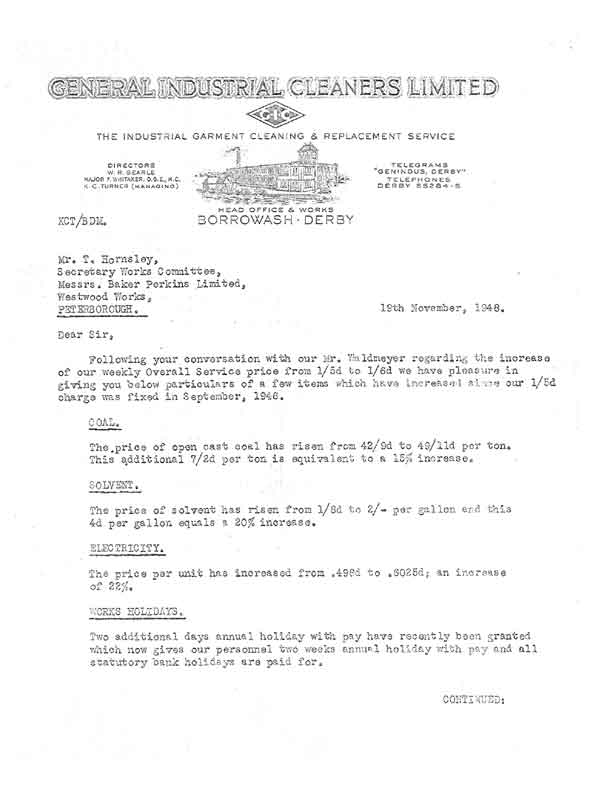
In the early days of the company, the men in the factory no doubt had to provide their own overalls, and it would be the responsibility of their wives to clean and wash them. They would also have had to make repairs such as replacing lost buttons and sewing up tears and snags.
Over time, the company agreed that it should provide protective clothing for the men and accepted all the costs involved. Every factory worker had three sets of overalls, one to wear, one away for cleaning and one retained in the individual's locker. Banks of these individually numbered lockers, to which each man had his own individual key, were placed at strategic places around the factory. This ensured that a clean overall was always available to the each man. Not only were overalls provided but also the smocks worn by Supervision and Chargehands. Different colours were used as follows:
Every Wednesday morning, a large van from the suppliers would arrive at the factory entrance. Security would direct it to the Overall Store which was just a short distance down the factory yard. Here Martha Brown and another lady would receive the garments and check that all was correct before signing for the delivery. They would also have the dirty overalls ready for the driver to take away for cleaning and returning the following week. Overalls and Smocks in need of any repairs were clearly marked to indicate just what was required.
Every Thursday morning Martha and her colleague would deliver the cleaned overalls to the locker sites, using a low level four-wheel platform truck, and place them in the appropriate lockers. There were occasions when overalls were not returned, or repairs were not carried out satisfactorily. Martha, in her own particular way, would somehow resolve the problem.
 |
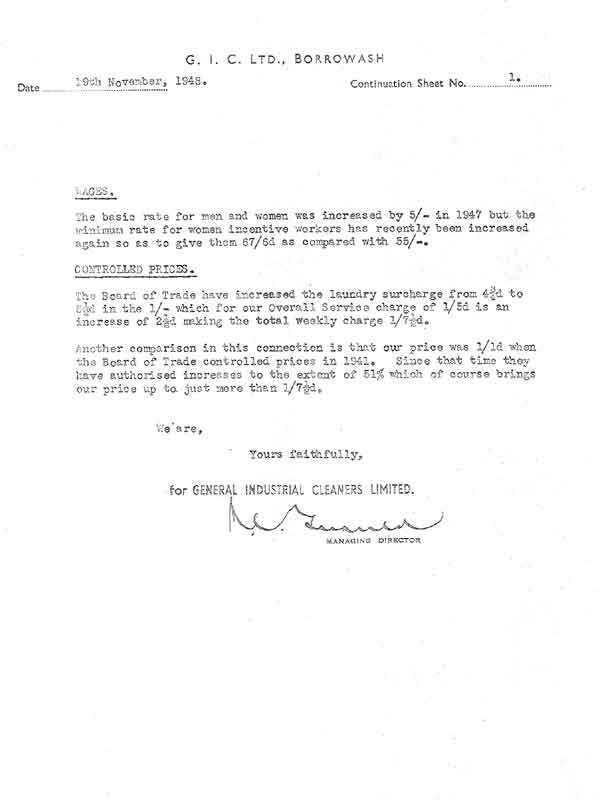 |
| 1948: Cost increases | 1948: Cost increases |
Mr. Cecil Gray was appointed as a full-time dental surgeon in 1943 as a considered policy for the general health of all employees, but more particularly for the health of the younger employees. At the time, although boys and girls coming straight from school had received the benefit of school dental services, they needed to have contributed a minimum amount to National Insurance before being able to qualify for National Dental Benefit.
Mr Gray wished to retire in 1951, by which time it was felt that the National Health Service, newly introduced in 1948, had removed much of the need to have a company service. The on-site dental service was discontinued soon after.
The Dentist had a drill operated by a foot treadle via a number of wires and pulleys. It was said that your toothache needed to be quite bad before treatment was to be contemplated.
In the 70s, Sun-Ray lamp treatment was available as a means of preventing the common cold. Sessions were booked in advance and involved several people standing in a circle around a sun-ray lamp for around 20 minutes.
While on the subject of the common cold, an ex-secretary recalls being able to obtain supplies of Cod Liver Oil capsules from the Medical Centre during the winter months.
All potential new employees had to have a Medical examination as part of their job application procedure. A number of senior employees also had to undergo a quite rigorous yearly check-up. For many years Doctor Marshall carried out this task.
Accidents and common illnesses were treated in the very well equipped Medical Centre. Sister Moules and Sister Gynn dispensed succour with a steely professionalism that soon separated the worthy cases from the malingerers.
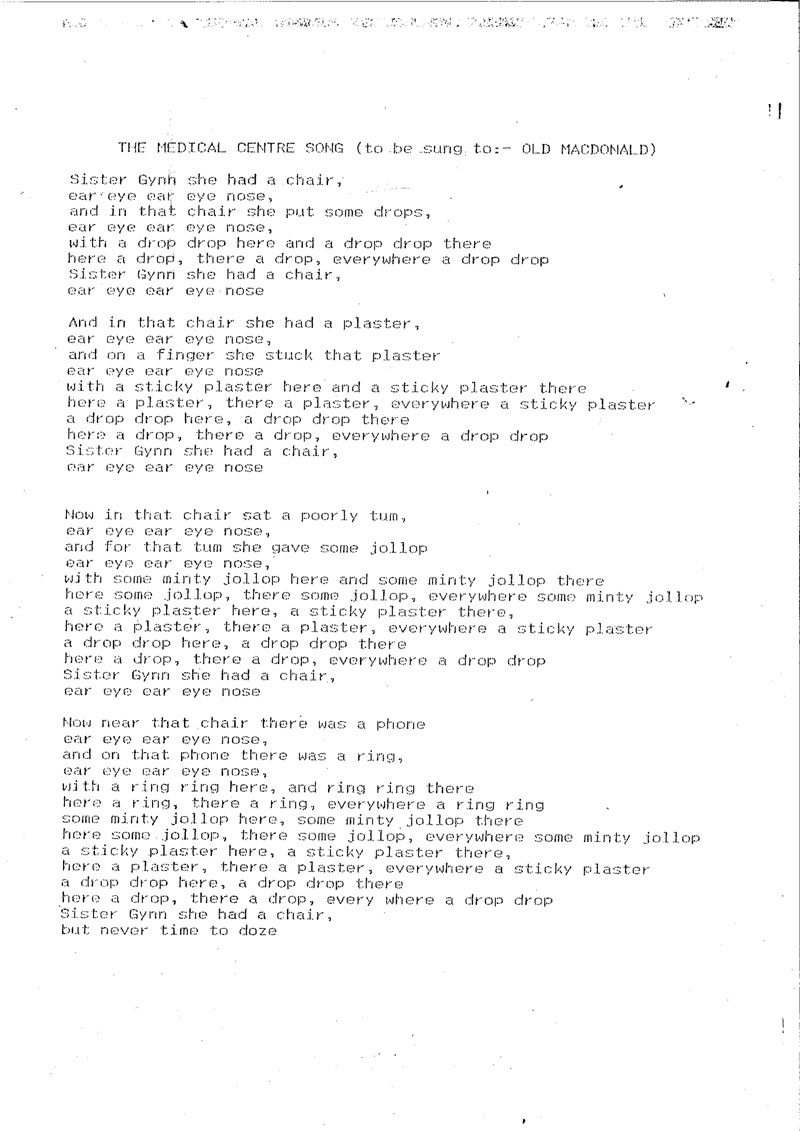 |
One of Kay Kisby's many poems. |
One young apprentice, suffering from a septic finger caused by coming in contact with a wire rope sling, was perturbed to be told by Sister Moules to sit down with his head between his knees. Sister Moules then ensured no undue movement with a judiciously applied thigh while releasing the infection by cutting the end of the finger with a pair of scissors. The patient recovered!
Rene Bowman, who worked in the Printing Department, recalls that she developed the X-rays that were taken in the Surgery (as it was then known). Not many companies could boast their own X-ray machine in those days.
Jim Farrow recalls visiting Sister Moules almost every Monday after playing football for the Works side at the weekend. Sister Moules applied her "black ointment" to his bruises and treated damaged fingers with hot wax. She often asked, in her very precise manner, why Jim continued to play the "silly game" - "I make you better and you go out and get injured again". Jim could only reply that he liked visiting her.
"Totectors", (steel toe-capped boots and shoes) and other forms of working footwear necessary for working in an engineering environment, could be purchased on site. A glance at the average apprentice's toe caps after a relatively short period of use illustrated just how necessary such protection was.
Appointments could be made for a haircut during working hours. We are not aware that any female employees took advantage of this service.
Bert Slater recalls a certain Mr Saunders as being one of the early company Hairdressers and we know that Mr. J. Thompson took up the position in 1945. The charge at that time was fixed at 1/- per haircut. This charge remained until 1951 when it was raised to 1/6d.
George Summerlin was the company Hairdresser from November 1954 until his death in December 1971, having moved from Bullard's Hairdressers in Midgate. George had a leg disability and to reduce the need for him to stand all day the Company bought a special hairdressers chair. This had a second chair for George himself to sit on which enabled him to swivel around the person having his "short back and sides".
We understand that George's place was taken by an Italian, one of the many that settled in Peterborough at the end of WW2.
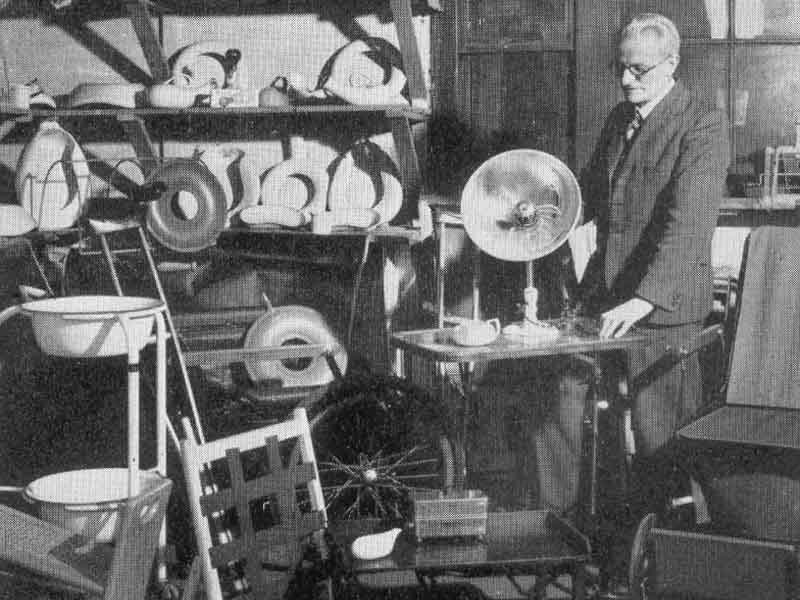
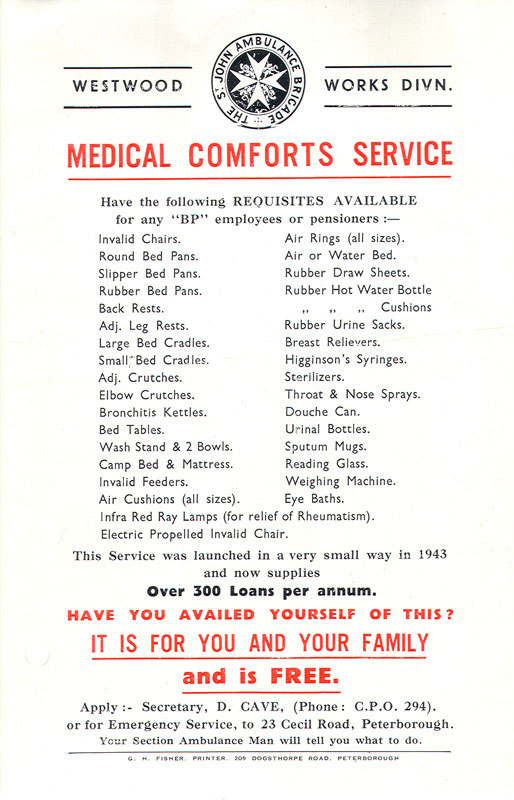 A very useful service, started in 1943 by members of the Westwood Works Division of St John Ambulance and taken over in 1981 by the Westwood First Aiders when the Brigade disbanded, providing on free loan all sorts of basic medical and home nursing items which were in short supply after the War and before the advent of the National Health Service. Medical
devices such as bedpans, back-rests, etc. were loaned out to employees, pensioners and members
of their families when illness or accident struck. This service was also referred to as the Medical Comforts Fund - was financed by voluntary contributions from individuals and donations from various company-related funds. Between 200 and 300 loans were made each year.
A very useful service, started in 1943 by members of the Westwood Works Division of St John Ambulance and taken over in 1981 by the Westwood First Aiders when the Brigade disbanded, providing on free loan all sorts of basic medical and home nursing items which were in short supply after the War and before the advent of the National Health Service. Medical
devices such as bedpans, back-rests, etc. were loaned out to employees, pensioners and members
of their families when illness or accident struck. This service was also referred to as the Medical Comforts Fund - was financed by voluntary contributions from individuals and donations from various company-related funds. Between 200 and 300 loans were made each year.
The service was administered by a committee of three, originally C Russell Bullard, Doug Cave (Secretary and Treasurer) and William Weston. Doug Cave retired in December 1958 and was succeeded by Stan Dawson (Divisional Supt of SJAB Westwood Works). By this time the other members of the committee were W J Green (Divisional Officer) and A C Garrod; H W Taylor had joined by 1967, and John Harrold by 1970.
 |
In 1981, responsibility for administering the Medical Comforts Fund was transferred from WW Division of the StJAB (wound up) to the First Aid Section. Overall responsibility rested with the Personnel Department - L J M Gibbard - but was delegated to Jim Farrow. Mick Sweeney, the senior First Aider, was in charge of loans and returns. |
As evidence of the esteem in which employees held the Medical Comforts Scheme, when items were returned from loan, they were often accompanied by a significant donation to funds.
From where Alf Jones administered the business of the Sports Club for many years, aided by Ursula Allen.
All content © the Website Authors unless stated otherwise.