
|
Help | | | News | | | Credits | | | Search | | | Guestbook | | | Forum | | | Shop | | | Contact Us | | | Welcome |
Westwood Works 1903-2003 |
|||||||||||||||||
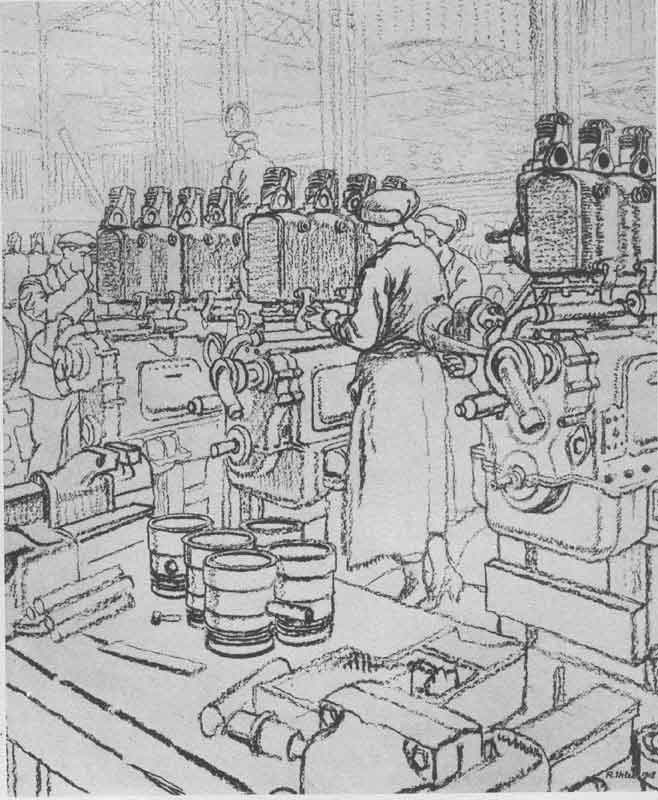
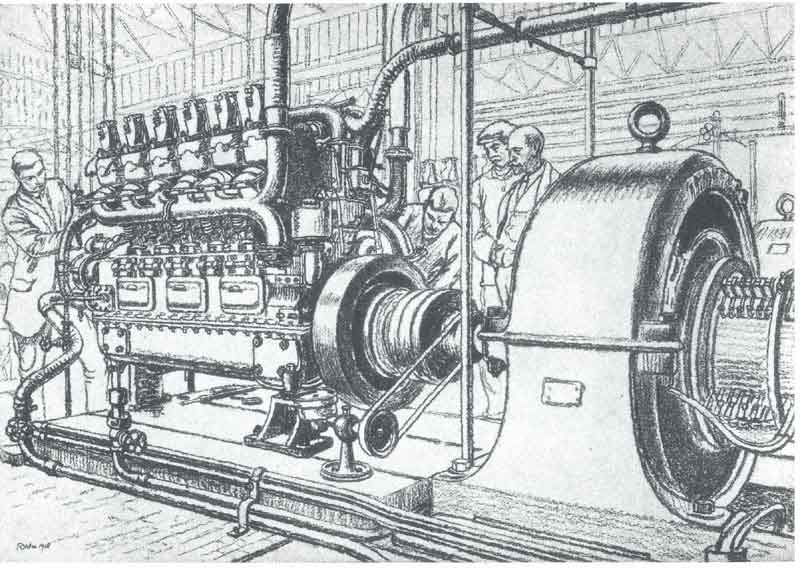
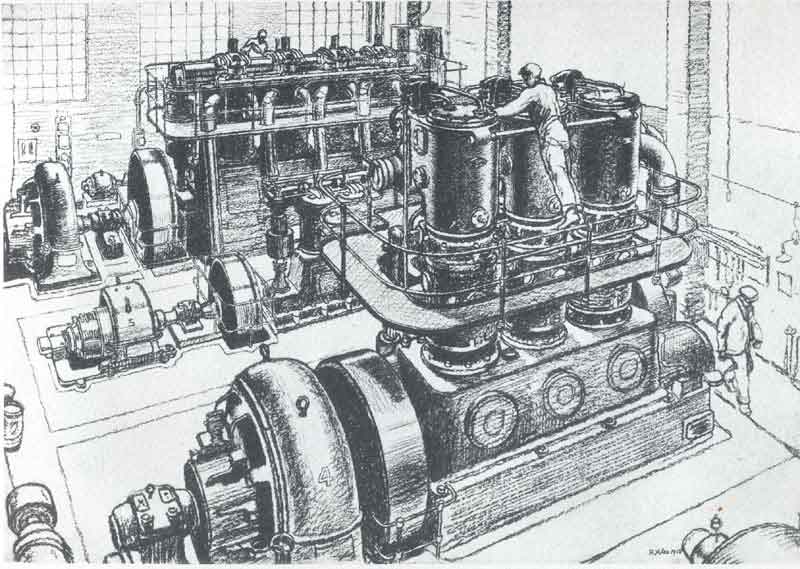
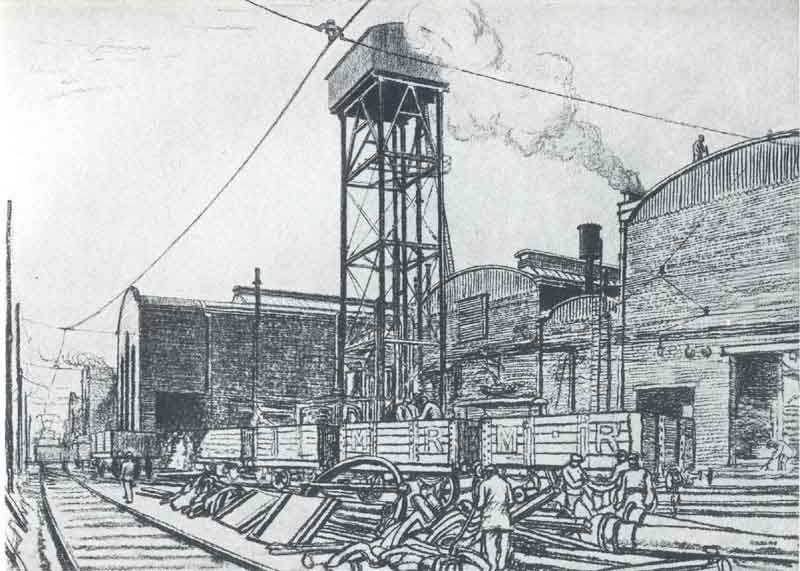
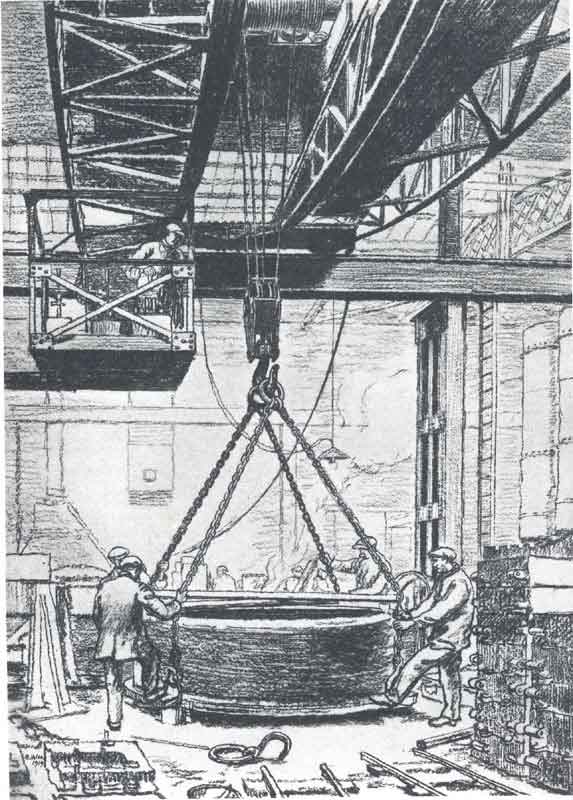
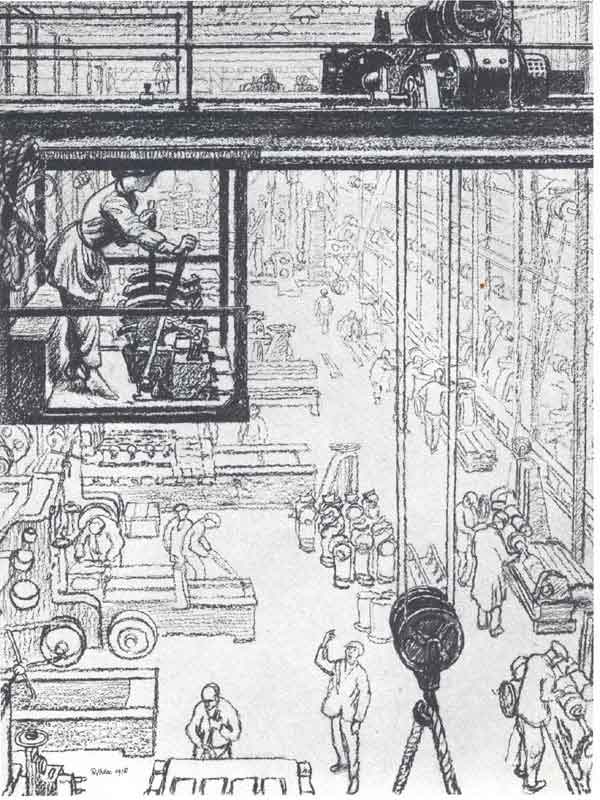
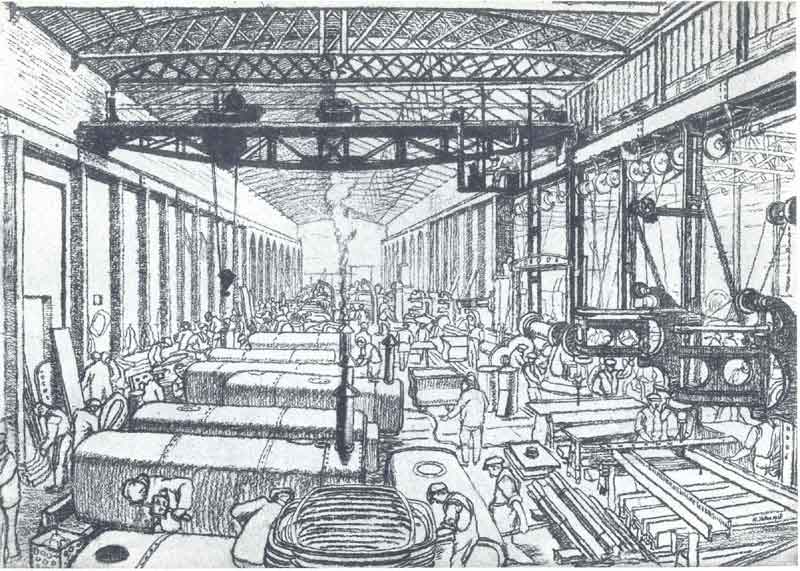
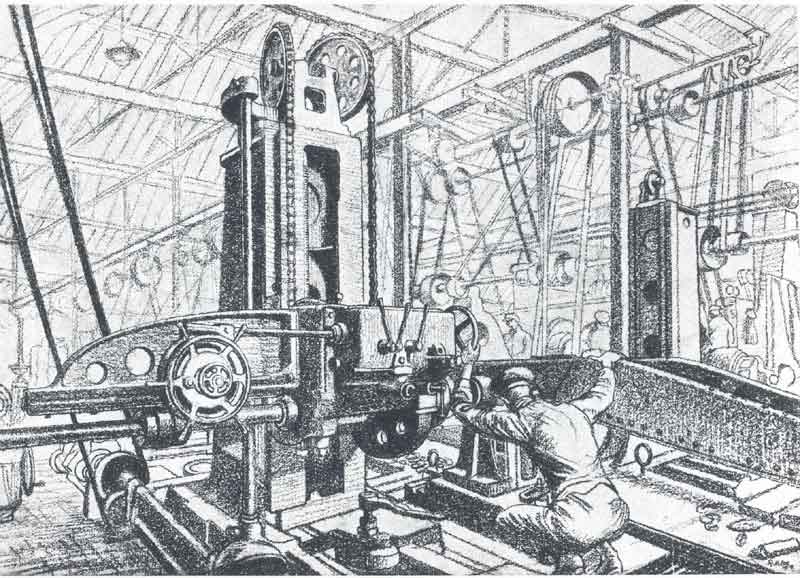
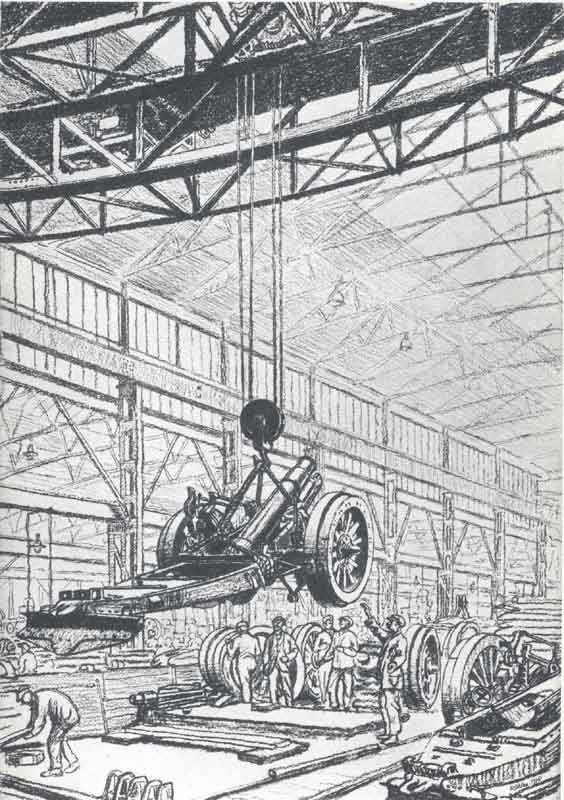
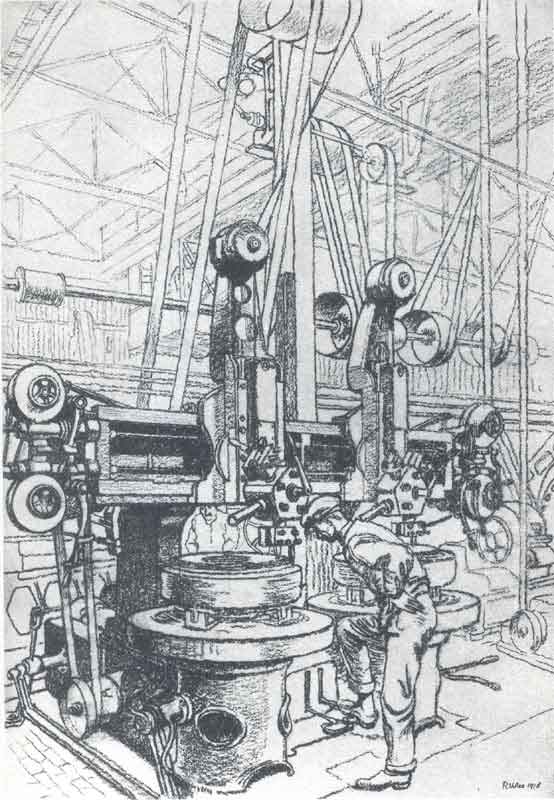
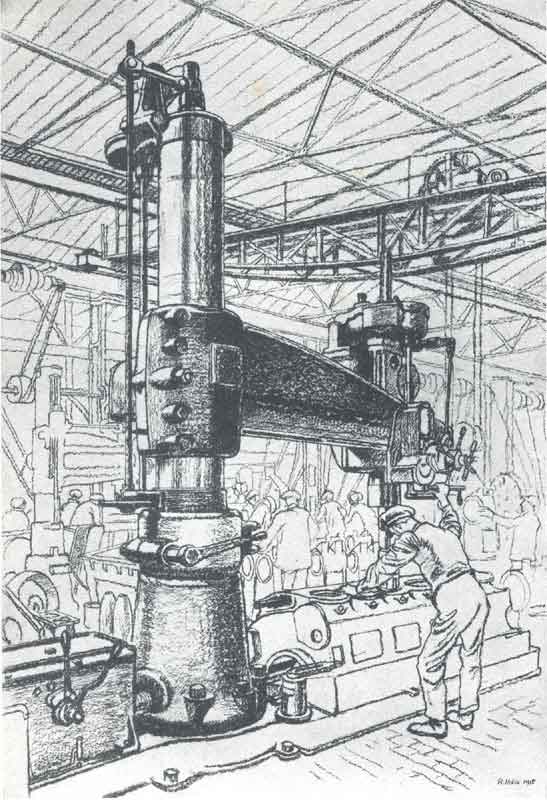
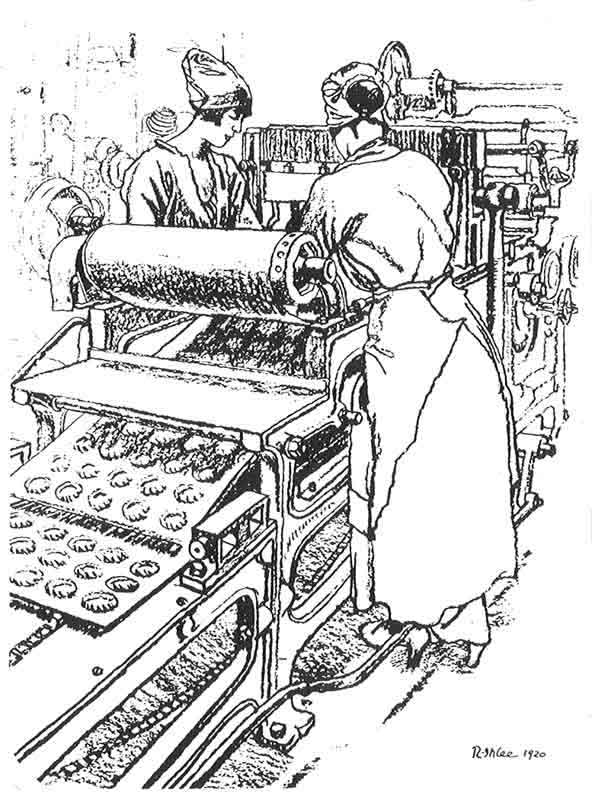
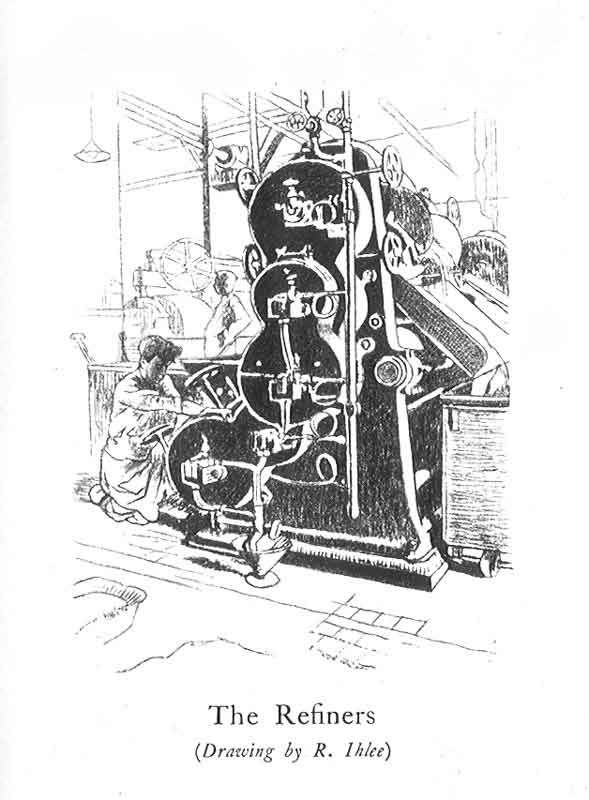
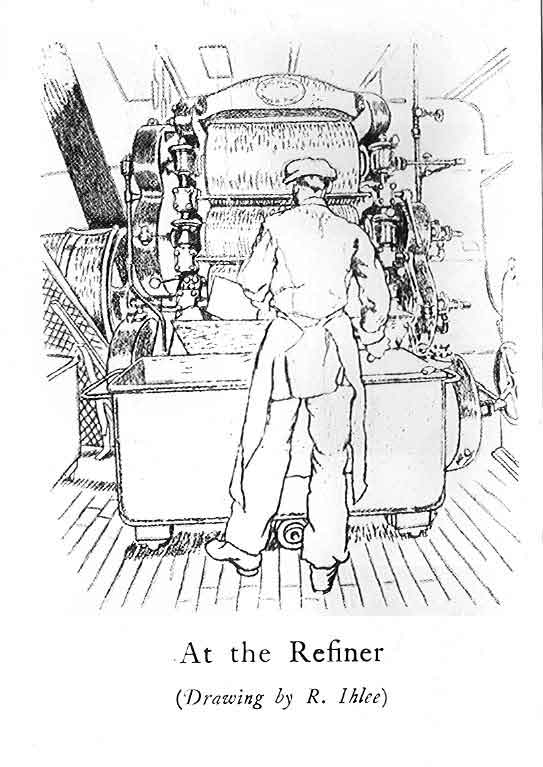
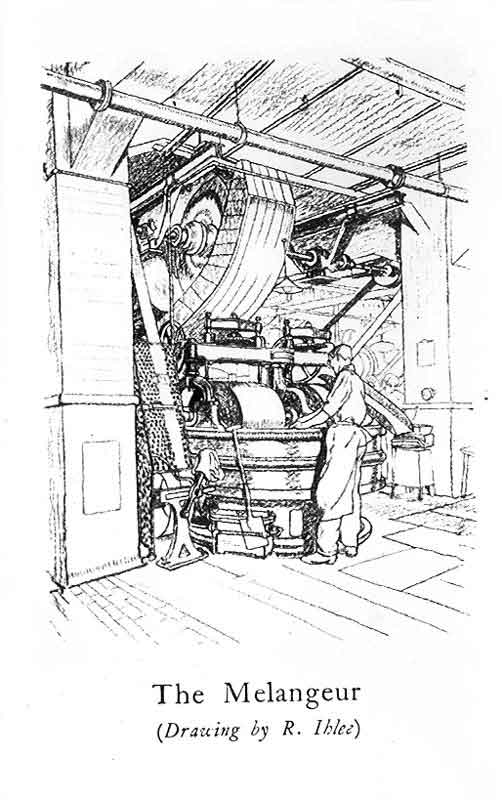
This section includes some of the lithographs produced by Rudolph Ihlee in 1918.
 |
 |
 |
 |
 |
 |
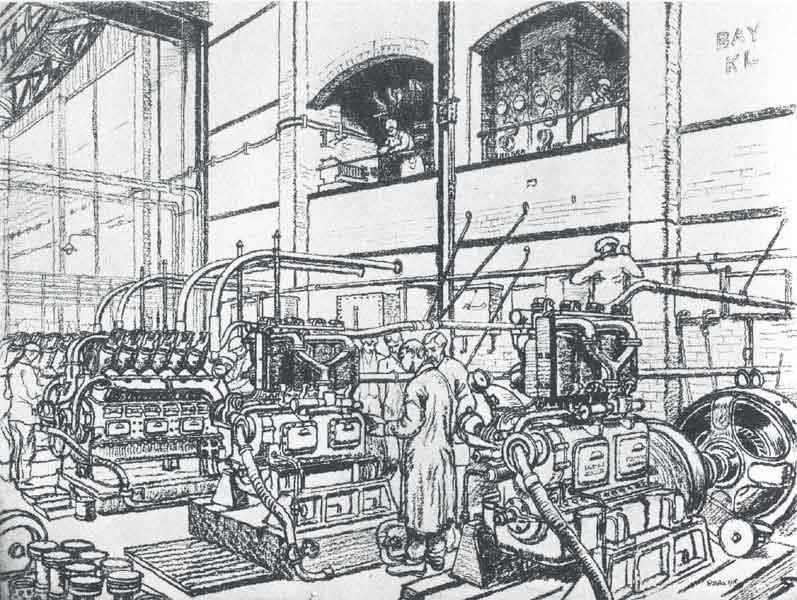 |
| Girl assembling petrol engines for tanks, type 100hp "Ricardo" | Petrol engines for tanks being tested, type 300hp "Ricardo" | Power house | Water tower, seen from railway sidings | Electrically operated crane lifting mould for casting in the foundry | Crane in the machine shop, seen from crane in adjoining bay of machine shop | Petrol engine test beds |
 |
 |
 |
 |
 |
||
| Plateworking shop: howitzer carriages and travelling field ovens | Howitzer trail being machined in horizontal boring machine | Complete 6" howitzer in erecting shop being removed for despatch | Petrol engine flywheels being machined in Duplex vertical boring machine | Crankcase of 300hp petrol engine for tanks being machined under radial arm drilling machine |
It is likely that all of these lithographs were made in 1920 as they appear to show Joseph Baker & Sons Ltd equipment. This was at the time of the merger between Perkins Engineers Ltd and Joseph Baker & Sons.
 |
 |
 |
 |
 |
||
| 1920: Biscuit Cutting Machine | The Refiners | At the Refiner | The Melangeur | At the Melangeur |
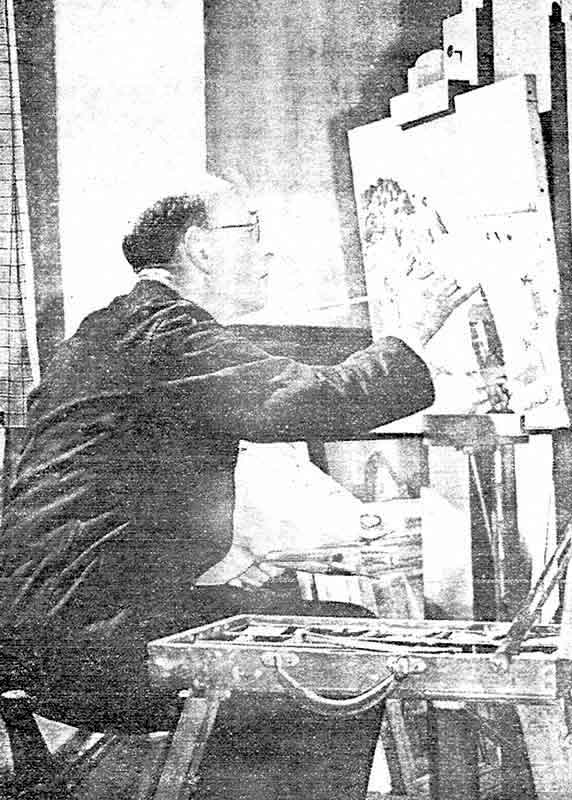 |
These lithographs were produced by Mr. Rudolph
Ihlee when working in the Westwood drawing office during the First World
War. Born in London, the brother of Mr. F.C. Ihlee, Chairman of the Board
of Management of Baker Perkins, he studied at the Slade School of Fine
Arts in 1906-10, winning a number of prizes. After two solo exhibitions
at the Carfax Gallery in 1914, he became a member of the NEAC, exhibiting
at the Leicester Galleries in 1921 with great success. He lived in Collioure
in the south of France for many years, marrying a French girl, Isabelle,
and just managed to escape back to England when France came under German
and Vichy government. They settled in West Deeping, near Peterborough,
where Rudolph continued to paint for the rest of his life but was uninterested
in selling his work - it simply accumulated at his house. He died in 1968,
after which a niece and her husband sold them off through a London gallery.
His widow moved to Stamford where she died aged 90. Rudolph was said to have had a very practical mind - "typical of that family; as good at practicalities as at intellect and with the same rather severe intolerance of inefficiency that F.C. Ihlee is said to have had". (See also History of Werner Pfleiderer & Perkins - F.C. Ihlee). |
James de la Mare recalls:
"Rudolph Ihlee was my grandmother's younger brother. He worked at Westwood during the 1914-18 war, having trained as an artist before the War. After the War he went to live abroad (like many artists) in the south of France. He married a French woman and stayed there until the Second war, when life became more dangerous and uncertain, so they returned to the UK, eventually settling at West Deeping. I always understood they were among the last to leave France hurriedly before the Vichy government clamped down on foreigners at the behest of the Germans who had by then occupied the north of the country.
He continued to paint there in the 1950s-60s. I visited and stayed at the house at that time. As Rudolph was not interested in selling the pictures he painted (or at least, did not seem to be!) they accumulated in his studio, stacked up vertically in a long line across the floor. I remember that clearly.
After he died (about 1968, I think) his French widow, Isabelle, sold the house and went to live in Stamford where she was always very hospitable towards visitors like myself. Eventually she died at the advanced age of 90. They had no children. Rudolph's accumulated paintings were sold off by a niece through a London gallery.
When he was old he couldn't turn his head so when he backed his car down into the road his wife was sent there to watch out for traffic, and he, staring straight ahead, put the car into reverse and put his foot on the throttle - hoping he'd keep the car in a straight line until he reached the road outside! A hazardous and alarming way of driving, I used to think!"
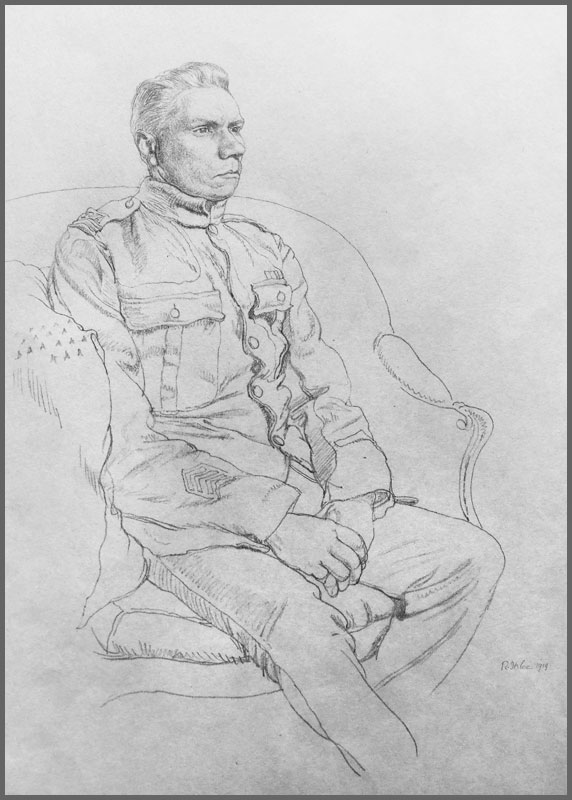 James de la Mare has obtained another superb Rudolph Ihlee drawing, this time
of a soldier from WW1. James is attempting to identify the subject and has
contacted the Imperial War Museum in an effort to learn more from the man's
uniform. They have replied:
James de la Mare has obtained another superb Rudolph Ihlee drawing, this time
of a soldier from WW1. James is attempting to identify the subject and has
contacted the Imperial War Museum in an effort to learn more from the man's
uniform. They have replied:
"It is likely that the representation is that of a Gunner of the Royal Artillery, His service dress jacket is of the 1907 pattern (as worn by non-commissioned ranks) and features the re-tailored collar that was fashionable around 1918. To his lower left sleeve he wears an inverted chevron, confirming a period of two years with good conduct. To the right, he wears four overseas service chevrons, each awarded for a 12 month period (worn from January 1918), indicating that this man had been out since 1914, an 'Old Contemptible'. (The lower chevron would have been of red embroidered cloth, the other three of blue). A single vertical stripe on the lower left sleeve indicates an award for a wound.
Above his left breast pocket is a medal ribbon, and I suggest that this is the 1914 Star, awarded to servicemen who has served in France or Belgium between 5th August and 22nd November 1914. The fact that the medal was sanctioned in 1917 tends to re-enforce the evidence". (NOTE - An illustration of this medal can be seen here).
It is likely that as Rudolph Ihlee was working at Westwood in 1918/19, the soldier could have been a Baker Perkins employee or a relation of somebody who knew Rudolph at Baker Perkins, and asked him to draw the soldier in uniform before de-mob. The sketch is signed by Rudolph Ihlee, "1919" and is 13 inches(H) by 10 inches(W).
If anyone had a relative who served in the Royal Artillery for the whole of WW1, we would be pleased to hear from you.
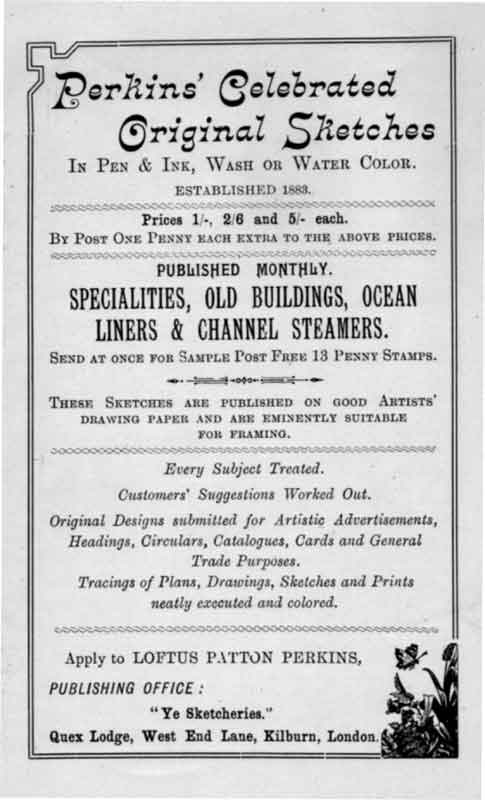
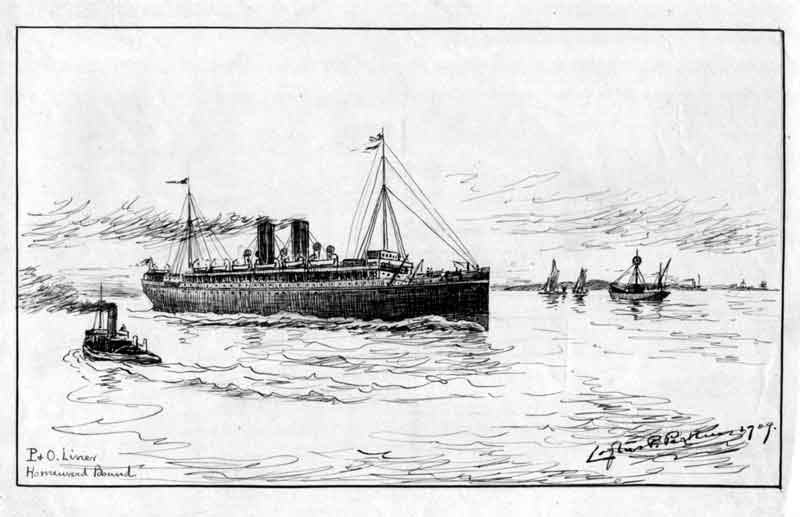
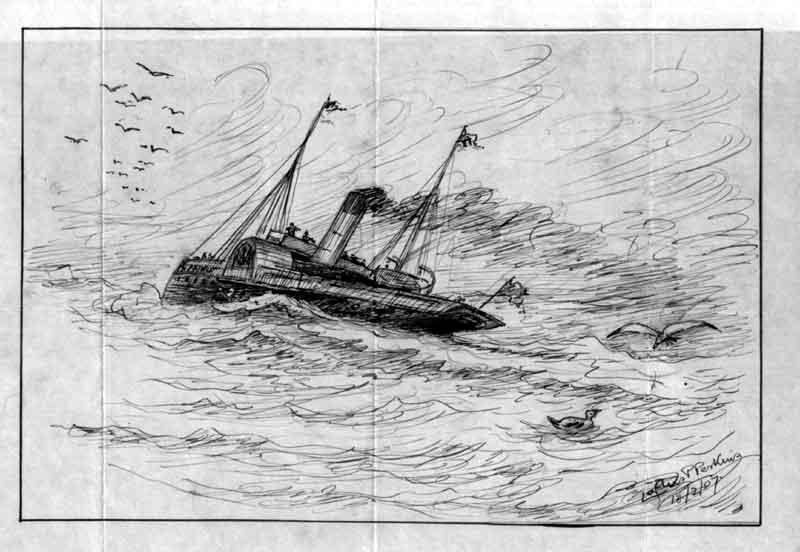
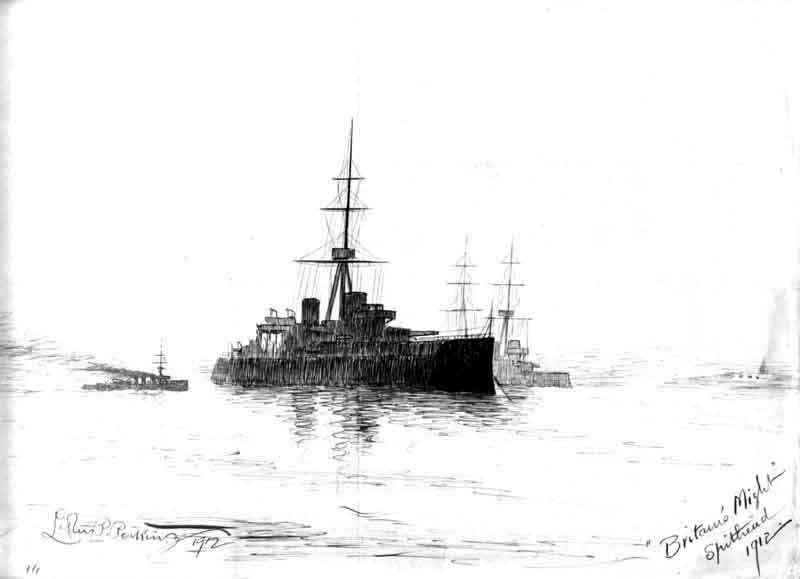
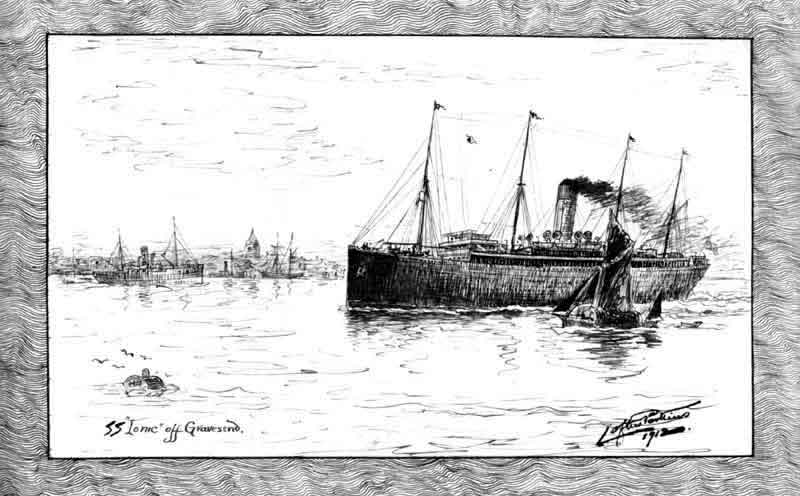
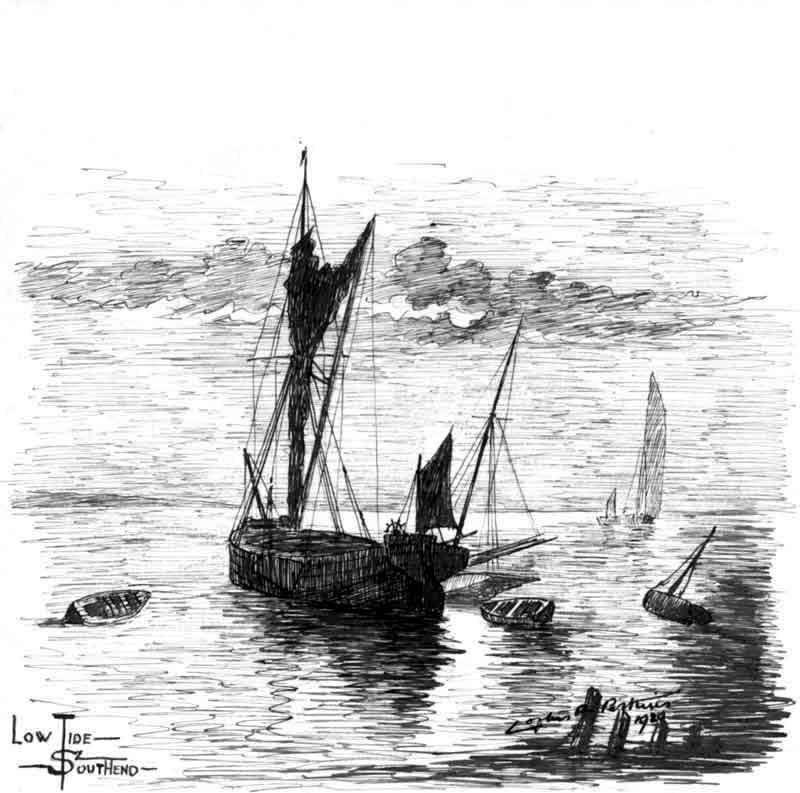
This website features the work of a number of gifted artists - Rudolph Ihlee, Frank Ball and Bob Bains - but another, earlier artist was Loftus Patton Perkins, the eldest son of Loftus Perkins (Jacob's grandson). In 1883, Loftus Patton was advertising "Perkins' Celebrated Original Sketches" from an address in Kilburn. Some of these are shown below:
 |
 |
 |
 |
 |
 |
 |
Following the merger between A.M. Perkins & Sons Ltd and Werner & Pfleiderer in 1893, Augustus Muir tells us that "Paul Pfleiderer was to be the dominating element in its management. The two sons of Loftus Perkins protested at the way things were developing. Any semblance of control at Regent Square had passed out of the hands of the Perkins family. Loftus Patton Perkins, the elder son, was offered a clerkship in the office at a pound a week".
Judging by the dates on the sketches reproduced above, Loftus Patton Perkins continued to earn at least part of his living as an artist.
Yet Another Artist in the Family
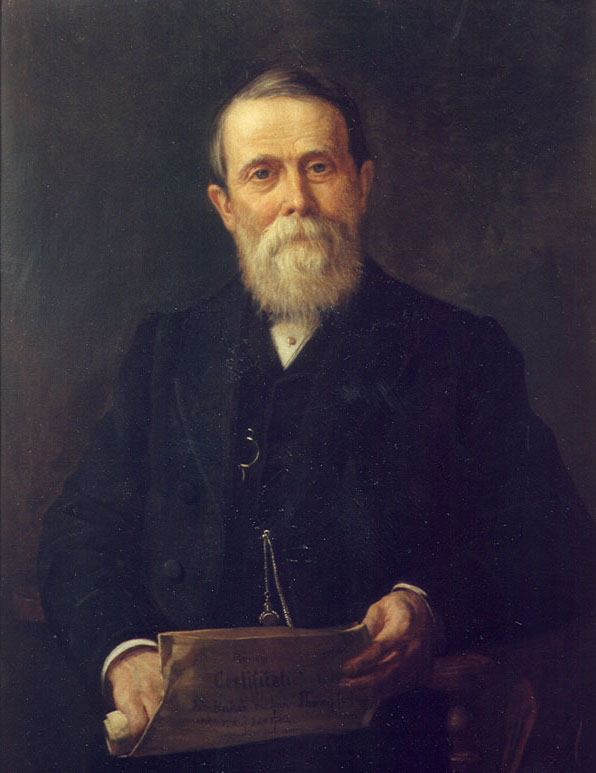
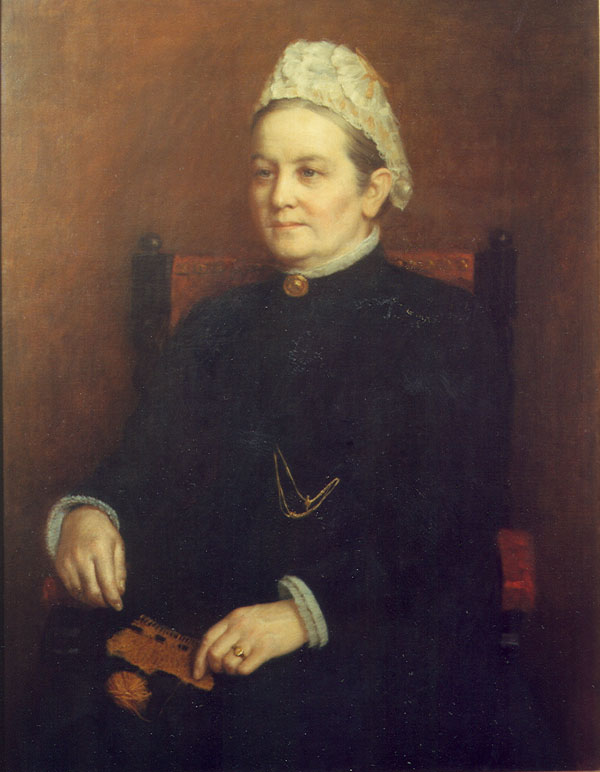
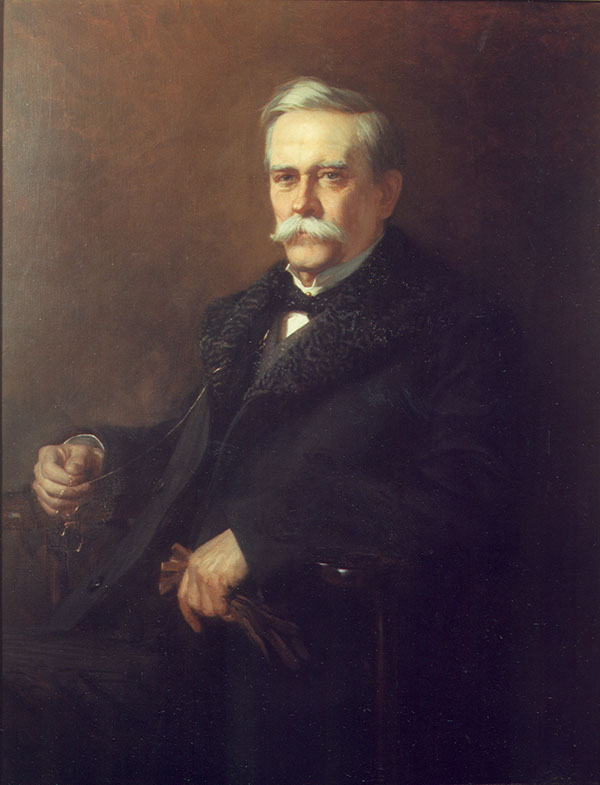
A series of “Board Room portraits” graced the walls of the Holdings Company building in Westfield Road. Only the first three – Jacob Perkins, Joseph Baker and Joseph Allen Baker – were “pairs”, accompanied by their wives. Apparently it was very unusual for businessmen to have portraits painted of their wives. All three pairs of portraits not only still survive, but hang on the walls of the office of John Cowx, one of the two owners of the business today.
 |
 |
 |
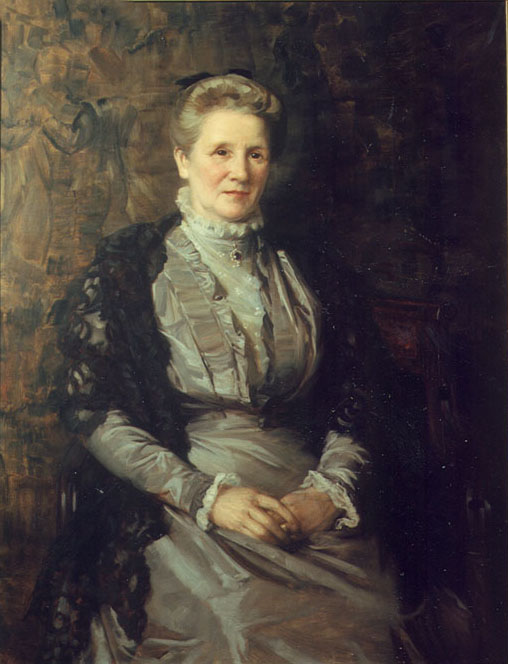 |
| Joseph Baker | Sarah Ann Baker | Joseph Allen Baker | Elizabeth Baker |
The portraits of Jacob Perkins (1766-1849) and his wife Maria, were by Chester Harding. However, research suggests that those of Joseph Baker (1823-1892) and his son, J. Allen Baker (1852-1928) and their wives, Sarah and Elizabeth, were by James Doyle Penrose who, perhaps surprisingly , had a connection with the Baker family.
James Doyle Penrose (1862-1932), was the grandson of Samuel Baker's eldest child, Abigail, who married George Doyle Penrose in 1826 and returned to Ireland sometime after 1829. (It is understood that the Penroses had connections with the Irish Waterford glass family). James was born in Co. Wicklow to Abigail's second child, also named James Doyle Penrose, and his wife, Anne Bowles. James Doyle (Junior) Penrose married Elizabeth Josephine Peckover. The Peckovers were bankers and Quakers.
James became quite a successful portrait painter and lived in Wisbech at his wife's family home, Peckover House, now owned by the National Trust, One of their sons married Philip Baker's elder daughter, Bertha.
All content © the Website Authors unless stated otherwise.